Earth's radiation budget, that’s the balance between incoming sunlight and outgoing heat, drives our climate system. Understanding it requires measuring radiation escaping from every corner of our planet, but current satellite observations face a fundamental trade off. Low Earth orbit satellites provide detailed snapshots but miss temporal continuity, whilst geostationary satellites maintain constant watch but can't see the whole globe at once. Time for an unusual solution, enter an unlikely observation platform: the Moon.
Chinese researchers have demonstrated that observing Earth from the lunar surface provides a unique solution to this problem, capturing our planet's radiation budget as a unified whole whilst filtering out confusing local weather variations. The study reveals that Earth's outgoing radiation has distinctive mathematical patterns, almost like planetary fingerprints, that only become clear when viewed from 384,000 kilometres away.
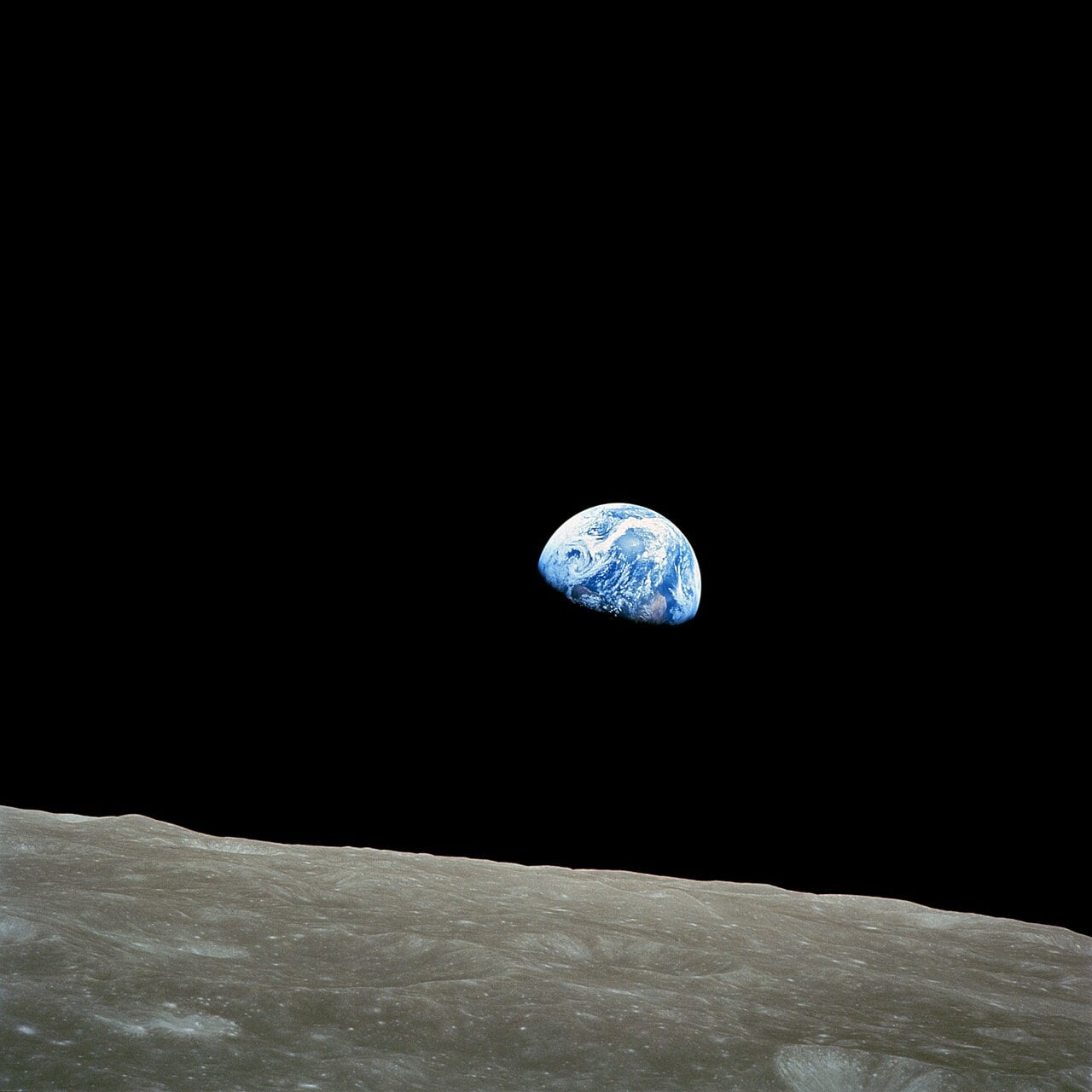
From the Moon's perspective, Earth appears as a complete disk rather than a patchwork of overlapping satellite views. This holistic vantage point allows scientists to extract planet scale signals whilst suppressing what Dr Ye Hanlin from the Institute of Atmospheric Physics calls “small scale weather noise." Traditional satellite observations excel at capturing regional or local radiation characteristics, but struggle to see the forest for the trees.
The research team, comprising scientists from the Chinese Academy of Sciences and the University of Chinese Academy of Sciences, analysed how Earth's emitted radiation varies when observed from a lunar platform. They discovered something remarkable: these variations are dominated by just the first two orders of spherical harmonic functions, which together account for roughly 90 percent of the radiation patterns.
Spherical harmonics are mathematical functions that describe patterns on a sphere's surface, think of them as the planetary equivalent of musical notes that combine to create complex melodies. The dominance of just the first two "notes" in Earth's radiation symphony means the Moon based view naturally filters complexity whilst preserving the essential planet scale signals.
This filtering effect acts like noise reduction for Earth's radiation, allowing clear observation of genuine planetary patterns whilst local thunderstorms, cloud formations, and weather systems blur into the background. The result is what researchers describe as Earth's unique “fingerprints”, distinctive radiation signatures that characterise our planet as a whole.
"A Moon based platform provides a new, long-lasting holistic view of Earth, which is highly unique.” - Professor Guo Huadong, author of the study from the Aerospace Information Research Institute.
Accurately estimating Earth's outgoing radiation is crucial for climate models that predict future warming, ice sheet melting, and sea level rise. Current satellite networks provide excellent data, but gaps in coverage and differences between instruments introduce uncertainties. A lunar observation platform could provide an independent check on these measurements whilst capturing truly global patterns impossible to see from Earth orbit.
The concept isn't entirely new since NASA’s Deep Space Climate Observatory already observes Earth from the L1 Lagrange point, maintaining a constant view of our sunlit hemisphere. But a Moon based platform offers distinct advantages. Stable positioning for decades, the ability to observe Earth throughout its full range of phases, and a natural platform for long term monitoring stations that future lunar bases might establish are just some of the benefits of this fascinating new approach.
Source : Wanna know Earth's radiation? Let's see it from the Moon!