
How did life begin on Earth? Based on studies of fossilized bacteria, scientists theorize that life first emerged on Earth over 4 billion years ago as simple, single-celled organisms. Over time, these organisms evolved to incorporate photosynthesis and sexual reproduction, eventually giving rise to more complex multicellular organisms, plants, and, eventually, mammals. Despite this scientific consensus, the question of how inorganic chemicals came together to form organic molecules that gradually evolved into self-replicating systems remains unclear.
The most widely held theory, known as abiogenesis, holds that life arose naturally from non-living matter, but questions remain about the evolutionary pathways involved. In a recent paper, an international team of researchers from Japan, Malaysia, the UK, and Germany suggests that the answer may involve surface-bound prebiotic gels that existed long before the first cellular organisms emerged. Their research provides new insights into the origins of life on Earth and how scientists could search for it elsewhere in the Universe.
The team was led by Dr. Ramona Khanum, a microbiologist/astrobiologist from the Space Science Center (ANGKASA) at the National University of Malaysia (UKM). She was joined by multiple colleagues from the ANGKASA, the UKM Institute of Microengineering and Nanoelectronics (IMEN), the Institute of Physical Chemistry at the University of Duisburg-Essen, the Office of Research and Academia-Government-Community Collaboration at Hiroshima University, and the University of Leeds. Their paper, "Prebiotic Gels as the Cradle of Life," recently appeared in the journal ChemSystemsChem.
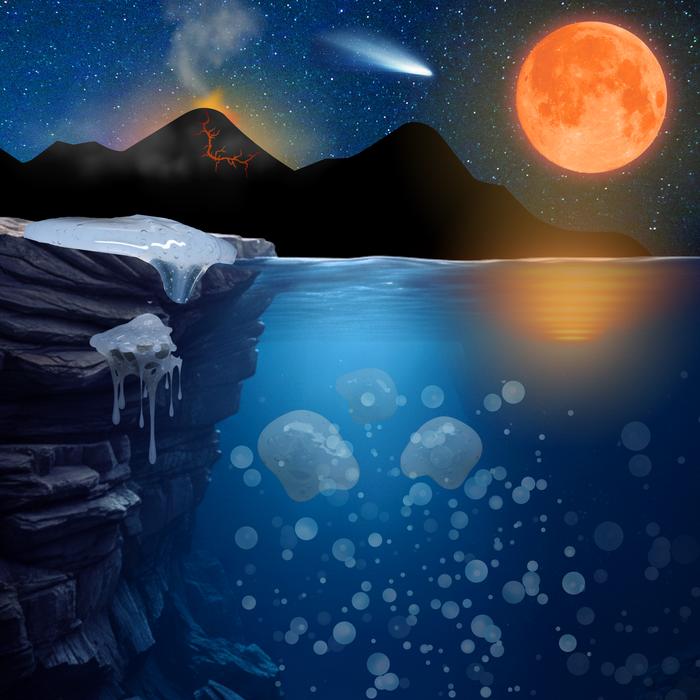 *Primitive gels could have concentrated and protected molecules, enabling complex chemical reactions long before cells formed. Credit: Nirmell Satthiyasilan*
The team's "prebiotic gel-first" theory posits that surface gels with properties similar to microbial biofilms (thin layers of bacteria) could have trapped and organized organic molecules. This would have provided the necessary structure for early chemical systems to emerge, which might have developed proto-metabolic and self-replicating behaviors, laying the foundation for life as we know it. This theory draws on soft matter chemistry and modern biology and takes inspiration from gels found today growing on rocks, in ponds, and on artificial structures.
As Professor Tony Z. Jia, a co-author on the study, said in a Hiroshima University press release, this represents a departure from conventional abiogenesis theories. “While many theories focus on the function of biomolecules and biopolymers, our theory instead incorporates the role of gels at the origins of life,” he said. What makes this theory intriguing is that it addresses a key barrier in prebiotic chemistry: by allowing for molecular concentration, selective retention, and environmental buffering, these gels ensured that the processes on which life depends were developed in advance.
Extended to the field of astrobiology, this theory suggests that similar gel-like structures ("xeno-films") could exist on other planets and bodies. These films may also be composed of different chemical building blocks that are unique to the local environment, perhaps giving rise to exotic life forms based on similar chemical regimens. This presents another intriguing aspect of the theory: the ways it could open opportunities for future astrobiological surveys. Instead of searching for specific chemicals, scientists could be looking for specific gel-like structures.
Said co-author Kuhan Chandru, a research scientist at the Space Science Center, National University of Malaysia (UKM):
This is just one theory among many in the vast landscape of origin-of-life research. However, since the role of gels has been largely overlooked, we wanted to synthesize scattered studies into a cohesive narrative that puts primitive gels at the forefront of the discussion.
 *Color image of Titan, Saturn's largest moon, processed by Kevin M. Gill at NASA/JPL-Caltech. Credit: NASA/JPL-Caltech/SSI/Kevin M. Gill*
These findings could assist the science teams for the ESA's *JUpiter ICy Moons Explorer* (JUICE), and the NASA Europa Clipper and Dragonfly missions. When JUICE and the Europa Clipper reach their respective destinations of Ganymede and Europa early in the next decade, perhaps they should be on the lookout for gel-like structures within the moons' ice sheets. But on Titan, which the Dragonfly mission will begin exploring in 2034, there could be even greater opportunities to leverage this research. Given Titan's rich prebiotic environment and organic chemistry, the odds of finding gels are more likely.
For the next step, the team will investigate their model experimentally by exploring how prebiotic gels might have formed from simple chemicals and under conditions present on Earth during the late Hadean (ca. 4 billion years ago). They further hope to determine what properties these gels could have provided to emerging chemical systems. “We also hope that our work inspires others in the field to further explore this and other underexplored origins-of-life theories!” said Khanum.
Further Reading: Hiroshima University, ChemSystemsChem
