A first ever detection of a coronal mass ejection from a small red dwarf could have big consequences for life on any nearby planets.
On Earth, Coronal Mass Ejections (CMEs) like the one we experienced earlier this month are aesthetic, even disruptive events, sending aurora southward and interrupting radio signals. But around other stars, they could prove lethal to life.
This point was driven home by a recent CME detection from an M-class red dwarf star.
This marks the first detection of an energetic Type II radio burst from a nearby star. The study titled Radio Burst from a Stellar Coronal Mass Ejection* was published in the journal Nature*. Researchers in the study used the Low Frequency Array (LOFAR) radio telescope, as part of what’s known as the LOFAR Two-Metre Sky Survey. LOFAR consists of an array of 20,000 dipole detectors, spread primarily across the Netherlands and neighboring countries.

“It is important because this is the first direct detection of such a stellar storm (a CME) on another star,” says Cyril Tasse (University of Leiden) “Before, we only had indirect hints. Now we can really see the shock moving in the star’s atmosphere, so we know for sure it is a CME.”
The source is M dwarf StKM-1262, a star with 60% the mass of our Sun. This M dwarf is located at Right Ascension 15h 37’ 10”, Declination +53º 19’ 19” north on the Draco/Boötes border, barely across the boundary in the constellation Draco the Dragon. The star is located about 130 light-years distant, and to date isn’t known to host exoplanets.
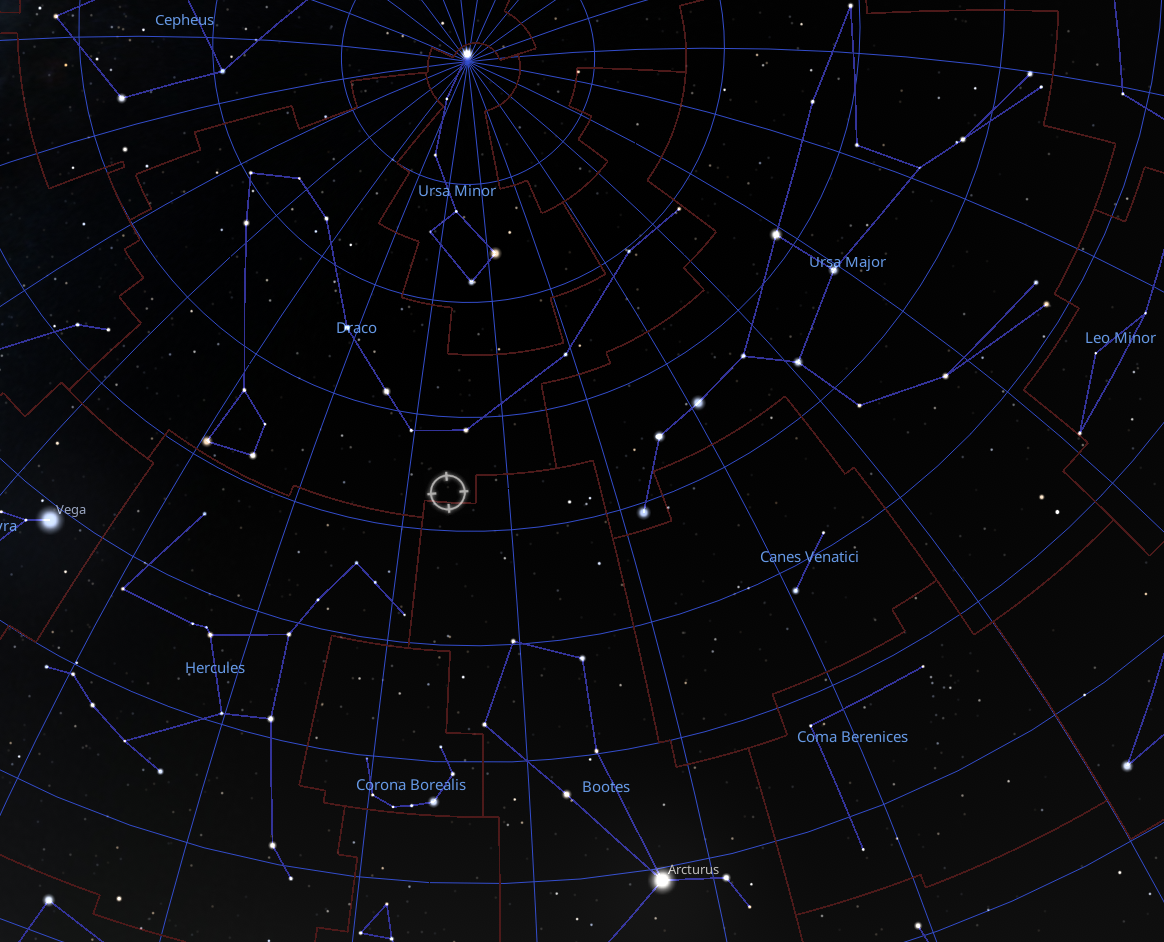
“It looks much more powerful than an average CME from our Sun! So not a good idea to be in its firing line,” says Joe Callingham (ASTRON-University of Amsterdam) “Especially since planets around M dwarfs, if in the habitable zone, are much closer to their host star than Earth is to the Sun.”
The European Space Agency’s XMM-Newton space telescope also followed up on the observation, monitoring the outburst at X-ray wavelengths.

“We used LOFAR to see the radio emission from the shock as it travels through the star’s corona,” says Tasse. “The emission frequency depends on the density of the plasma, so with LOFAR we can follow the shock. XMM-Newton, with its X-ray data, helps us measure or constrain the density profile of the corona, and we can get a physical measure of the CME.”

The study observed 86,000 stars out to 100 parsecs (326 light-years) from our solar system over an eight hour span to make the detection.
“It's 10-100 thousand times brighter than the sun's ones,” says Tasse. Assuming the star is fully convective, it is also likely more magnetized, and producing a stronger magnetic field with much bigger eruptions.
Red dwarfs are tempestuous stars, smaller but much more active than our Sun. They’re also the most common class of star in our Universe. But due to their faintness, not one can be currently seen from the night skies of the Earth.
“Since red dwarfs are the most common stars in the Universe, they are also the most likely place to find a planet,” says Callingham. “So we want to determine if a planet is potentially habitable around these stars. However, we really did not know how often these stars undergo these giant storms (coronal mass ejections). This is important to determine because even if the planet is in the habitable zone, it is possible the star blasts it with CMEs so often its atmosphere disappears.”
One thing red dwarfs do have going for them are terrestrial-sized planets. A majority of confirmed exoplanets orbit red dwarfs, which constitute 75% of the total population of main sequence stars. This includes the well-known TRAPPIST-1 system, and the recent trio of exoplanets seen orbiting TOI-2267.
Unfortunately, the implications from this discovery do not bode well, for the prospects for life on exoplanets around M-dwarf stars.
The discovery confirms what many researchers have long suspected, that prospects for life evolving on an exoplanet orbiting a red dwarf may be slim. Though the long miserly life span of red dwarfs is measured in the range of trillions of years, which is much longer than the current 13.8 billion year age of the Universe, planet-sterilizing CMEs are a definite downside. Although such a star may unleash a powerful CME once every 500 years or so, life needs time to evolve. Plus, the habitable zone around a red dwarf is tiny. Think of a solar system in miniature, versus our own. CMEs in our solar system can compress our magnetosphere almost down to the Earth’s surface, and a red dwarf flare could effectively strip a planet’s atmosphere.
“It tells us that ‘habitable zone’ is not only about liquid water,” says Tasse. “It is also about the magnetic environment. If the star produces many violent CMEs, a planet needs strong magnetic shielding to keep its atmosphere. So life as we know it around such stars might be more difficult.”
“Next is to collect more data and build real statistics. With future instruments like the SKA, we will detect many more events and understand how often these big CMEs happen and how they affect nearby planets.”
The next step is to examine exoplanets in orbit around red dwarfs in greater detail. JWST is working to detect atmospheres around Earth-sized exoplanets orbiting red dwarf stars. The SKA (Square Kilometer Array) currently under construction in South Africa and Australia and coming online for scientific observations in 2027 could detect tens to hundreds of CME flares from nearby stars in its first year of operation alone.

This study adds one more small piece in the puzzle, in answering just how common (or rare) our own story is in the larger context of the drama of the Universe. Red dwarfs may be tough neighborhoods when it comes to life, and that could well be why we’re here instead, orbiting a relatively placid G-type yellow dwarf Sun.