From 2013 to 2019, the Dark Energy Survey (DES) carried out a deep, wide-area survey of the sky in a collaborative effort to map hundreds of millions of galaxies, thousands of supernovae, and measure the rate at which the cosmos is expanding. For more than a century, scientists have been trying to constrain this cosmological phenomenon - the Hubble-Lemaitre Constant - named in honor of astronomers Edwin Hubble and Georges Lemaitre (who independently confirmed that the Universe is expanding in the early 20th century).
On Jan. 22nd, the DES released the results of its six-year campaign, providing the first comprehensive dataset involving all four methods of measuring the expansion of the Universe: baryon acoustic oscillations (BAO), Type-Ia supernovae, galaxy clusters, and weak gravitational lensing. The analysis imposes constraints that are more than twice as stringent as those in previous DES analyses, thereby narrowing the set of possible models of how the Universe behaves on the largest scales.
A Dark Influence
In so doing, scientists aim to measure the influence of Dark Energy (DE), the mysterious force responsible for this expansion, which has been accelerating for the past four billion years. The first indications of DE emerged with Hubble and Lemaitre, who had both proven and discredited a crucial theory proposed by Albert Einstein just years before. According to Einstein's field equations for his Theory of General Relativity, there had to be some force responsible for "holding back gravity" and preventing the Universe from contracting and imploding.
In Einstein's view, this Cosmological Constant (as he named it) was powerful enough to maintain the Universe in a static and eternal balance. He represented this unknown force in his equations using the Greek letter lambda (Λ). However, as contemporaries of his noted, depending on the value of the Constant, the Universe could also be in a state of expansion. Einstein rejected this idea, favoring the idea of an eternal Universe that was not subject to expansion or contraction. In 1931, Hubble invited Einstein to the Mount Wilson Observatory in California to witness what he had observed years prior.
While there, Hubble showed Einstein how redshift measurements showed that galaxies were moving away from our own. In fact, the farther away the galaxies were, the faster they were receding. Upon witnessing this, Einstein declared the Cosmological Constant the "biggest mistake" of his career. However, in 1998, two independent teams of cosmologists discovered that the Universe’s expansion is accelerating using distant supernovae. This contradicted what astronomers had previously suspected: that gravity would slow the expansion over time, and the cosmos would begin to recede.
This led them to propose that another phenomenon was responsible for cosmic expansion, which came to be known as "Dark Energy." In honor of Einstein originally proposing that there is a force working against gravity in the Universe, DE is also represented by the character Lambda. Today, astrophysicists hypothesize that this force accounts for approximately 70% of the mass-energy density of the Universe, although very little is known about it. In the years that followed, scientists began devising experiments to study DE, which bore fruit on Aug. 31st, 2013, when the DES began searching the cosmos.
Enter the DES
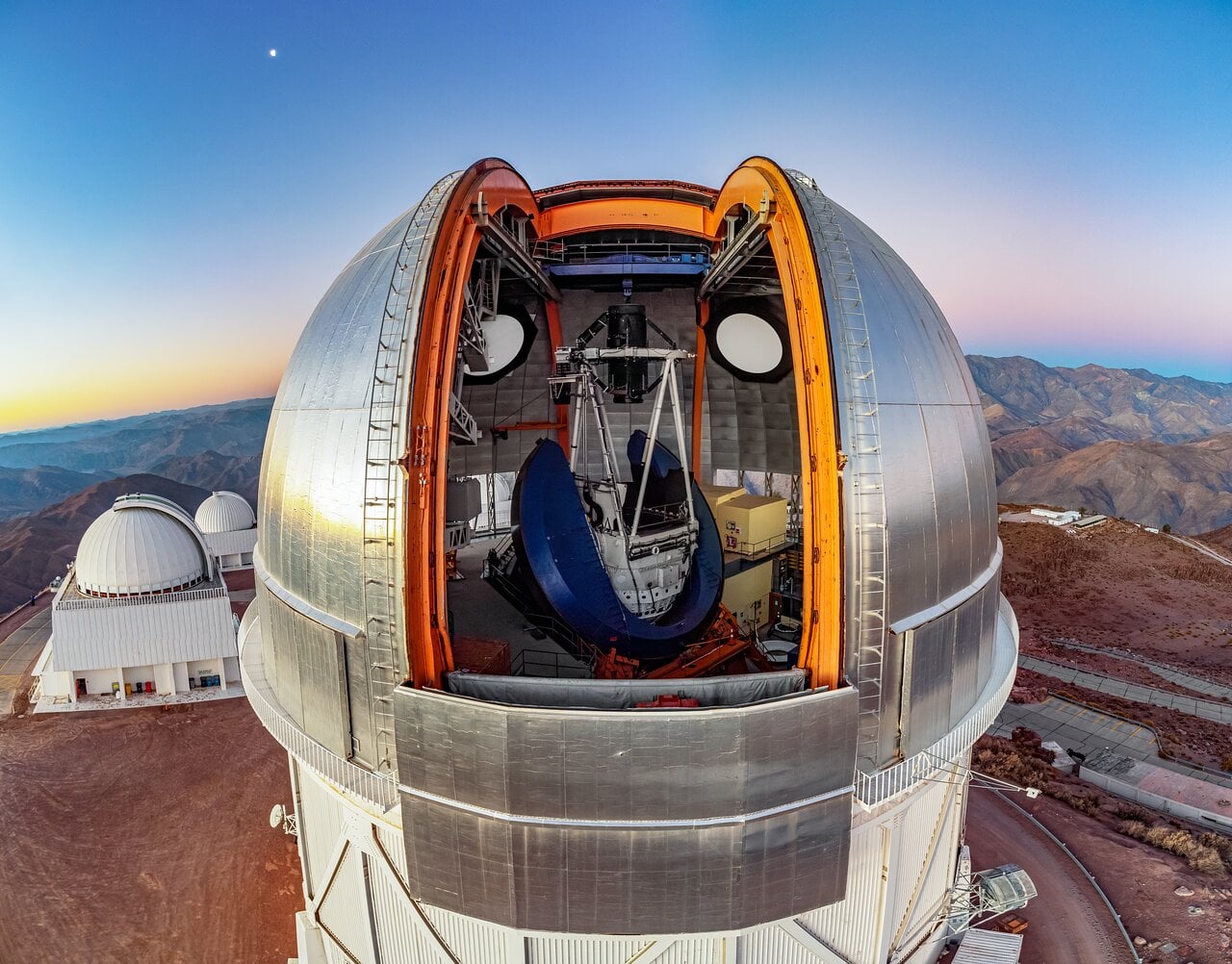
The DES is an international collaboration including more than 400 scientists from 35 institutions in seven countries, led by DOE’s Fermi National Accelerator Laboratory. This organization monitors the cosmos using its 570-megapixel Dark Energy Camera (DECam) mounted on the 4-meter Victor M. Blanco Telescope located at the NSF Cerro Tololo Inter-American Observatory (CTIO) in Chile. For 758 nights over six years, the DES Collaboration used these four methods to obtain information on an eighth of the sky containing 669 million galaxies located billions of light-years from Earth.
"It is an incredible feeling to see these results based on all the data, and with all four probes that DES had planned. This was something I would have only dared to dream about when DES started collecting data, and now the dream has come true," said Yuanyuan Zhang, an assistant astronomer at NSF NOIRLab and DES member.
"These results from the Dark Energy Survey shine new light on our understanding of the Universe and its expansion," added Regina Rameika, the Associate Director for the Office of High Energy Physics in the DOE’s Office of Science (DOE/SC). "They demonstrate how long-term investment in research and combining multiple types of analysis can provide insight into some of the Universe’s biggest mysteries."
In this latest analysis, the DES tested two models of Dark Energy against the six years of DES observations. This included the currently accepted Standard Model of Cosmology, the Lambda cold dark matter (ΛCDM), and the wCDM model. The ΛCDM model considers the DE density to be constant, while the latter considers it to be an evolving phenomenon. Their results were inconclusive, however, as their data fit both models of cosmology in equal measure. In addition, their results confounded one of the four parameters used to measure cosmic expansion: the galaxy cluster parameter.
Based on measurements of the early Universe, both DE models predict how matter clustered during later cosmological epochs. Whereas previous analyses of galaxy clustering were inconsistent with these models' predictions, the recent data have only widened the gap (though not enough to rule out one of them). For the next step, the DES Collaboration will combine its results with the most recent constraints from other DE experiments to investigate Modified Newtonian Dynamics (MOND), an alternative theory of gravity that does not require DE.
This analysis also paves the way for complementary data collected by the Vera C. Rubin Observatory, which will observe 20 billion galaxies across the Southern Hemisphere sky as part of its Legacy Survey of Space and Time (LSST). This data will be combined with experiments like the DES to enable even tighter constraints on cosmological parameters that will further inform our understanding of the expansion history of the Universe.
Further Reading: NSF NOIRLab, Physical Review D.