Ever since humans learned that there are countless stars in the Universe with their own planetary systems, we have wondered if intelligent life exists beyond Earth. For more than 60 years, scientists have engaged in the Search for Extraterrestrial Intelligence (SETI), but all these attempts have yielded no definitive results. This has led scientists to question their methods and the possible indications of technological activity (aka. technosignatures) they should be looking for. In addition, they have come to consider expanding the search to include different forms of communication.
One idea that has persistently guided SETI research is the notion that there exists one universal language: mathematics. While communicating with an extraterrestrial civilization (ETC) would be subject to cultural and biological barriers that we cannot anticipate, it is a foregone conclusion that numbers are the lingua franca of the Universe. For years, researchers at Monash University and the Royal Melbourne Institute of Technology (RMIT) University have conducted experiments that showed that bees can appreciate mathematics. Their work presents new possibilities and another possible framework for future SETI surveys.
The research, described in a paper published in the journal Leonardo (an MIT Press Direct publication), was conducted by researchers from the School of Biological Sciences at Monash, RMIT University. the Centre de Recherches sur la Cognition Animale (CRCA). As they note in their paper, humans share similarities in communication, cooperation, and mathematical ability that could be a model for interstellar communications.
The Language of Science
Part of the problem with interstellar communications is the sheer distance involved. This is one of the reasons why radio transmissions are considered a good candidate, since they propogate through space very well. Given the constraints of General Relativity, the likelihood of in-person contact is highly unlikely, and would most surely be through long-distance communication. Given the distances, return-communications would take decades or longer. And without a shared language, mutual understanding would be impossible.
The idea of mathematics as a universal language is time-honored. One of the earliest known examples is Galileo Galilee, who famously wrote in 1623 that the Universe was a grand book "written in the language of mathematics." This reflected the spirit of the Scientific Revolution (ca. the 16th to 18th century) and the focus on the natural world, which was held to be knowable and governed by rational laws. The concept has also been explored extensively in academic circles and through science fiction.
Notable examples cited by the team include Carl Sagan's novel Contact, which was based on the life of famed SETI pioneer Jill Tarter (and adapted into the 1997 film, The Three-Body Problem by Lui Cixin, and the 1998 novella Story of Your Life, which was adapted into the 2016 film Arrival. There are also several real-life examples where humanity has sent coded messages to space in the hopes that an ETC will find them someday.
First, there was the Arecibo Message, humanity's first attempt at Messaging Extraterrestrial Intelligence (METI) in 1974. Led by Frank Drake, who also led humanity's first attempt to search for extraterrestrial intelligence beyond the Solar System, this coded radio message was broadcast from the Arecibo Observatory in Puerto Rico. It contained information on mathematics, humanity, the Solar System, DNA, and the Observatory itself, all based on prime numbers arranged rectangularly into 73 lines of 24 characters per line.
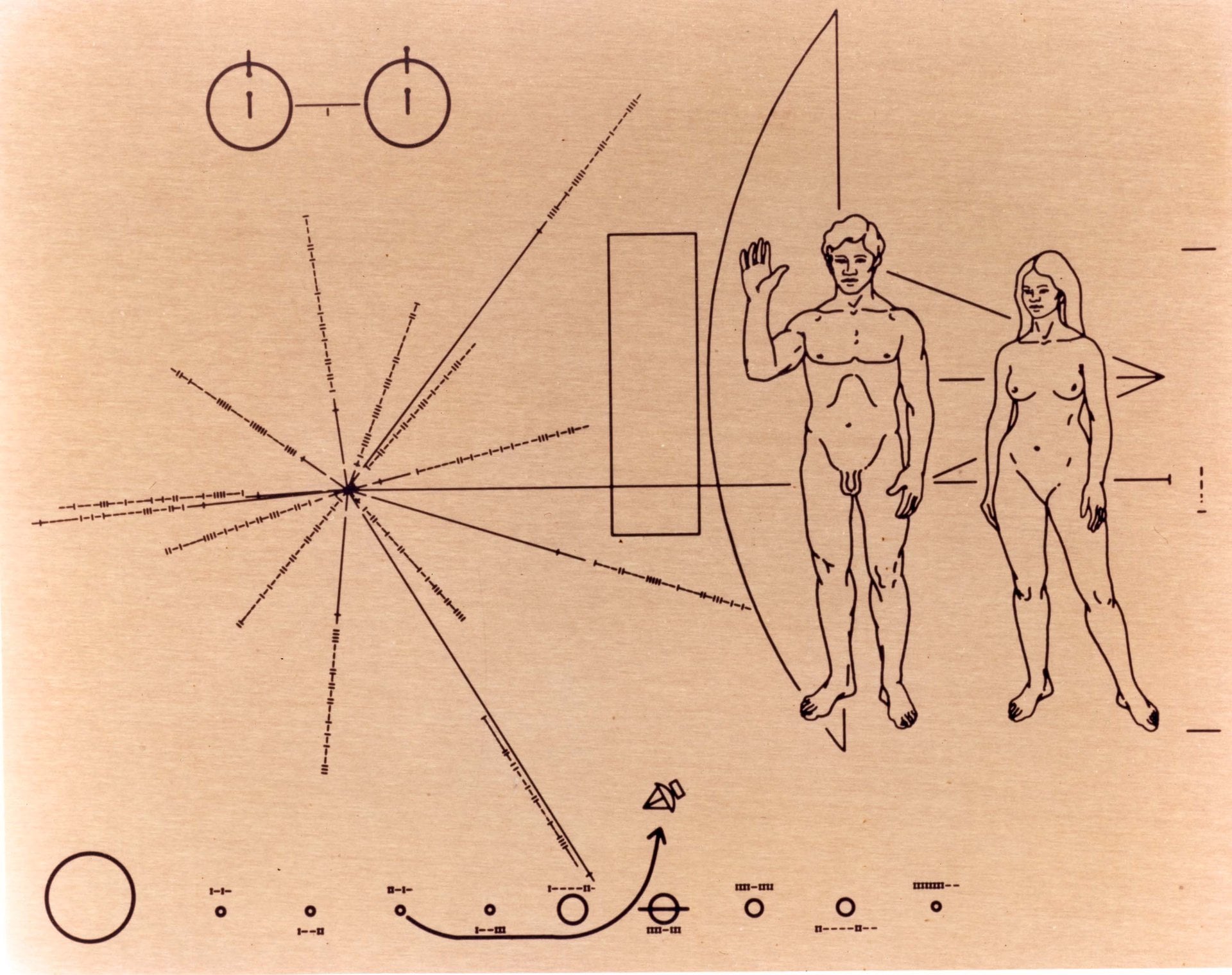
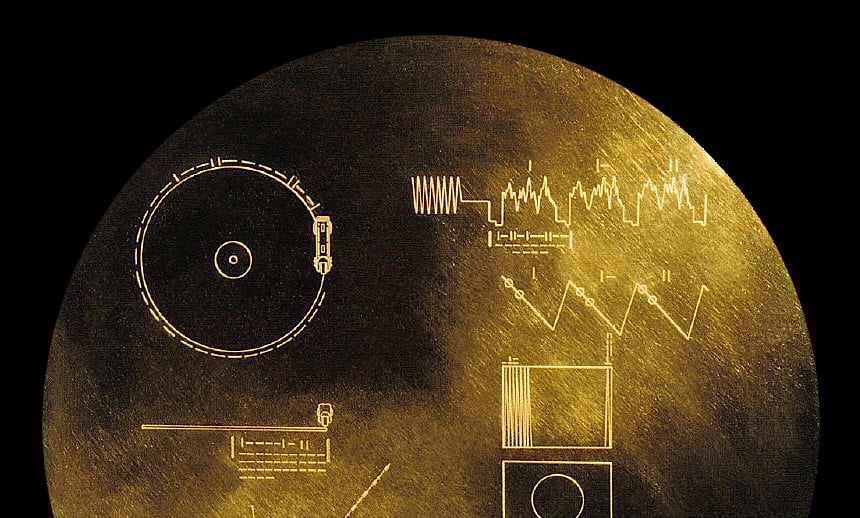
The there were the Pioneer Plaques that accompanied the Pioneer 10* and 11 missions, and the Voyager Golden Records carried by the Voyager 1* and 2 probes. All of these "messages," created with the help of Carl Sagan, Eric Burgess, and Frank Drake, were coded in the language of numbers and images. The Voyager Golden Records also contained sounds and images that depicted life on Earth, and their covers were etched with instruction on how to play the records, written in binary arithmetic and numbers.
Teaching Bees Math
Between 2016 and 2024, the team explored the ability of bees to learn mathematics. As they explain in their study, the evolution of bees and humans diverged over 600 million years ago, yet both possess the capacity for communication, social behavior, and mathematics. The divergence in our methods for communicating are especially interesting. Whereas humans have evolved to use verbal language to communicate, bees have evolved a physical language - the "waggle dance." Through the motions of their limbs, bees are able to communicate the location of resources (i.e. pollen and nectar) and other vital information.
This includes both the distance and direction of the resources, as well as the angle of the Sun, and even the quality of the resources. Much like spoken language that humans have evolved to use, the waggle dance provides bees with a means of communicating and coordinating themselves within their complex society. While our brain structures and sizes also differ greatly, the behavior of bees could be described as a bona fide form of intelligence. In this sense, the communication patterns of bees and other insects could serve as a model for searching for similar types of intelligence in our Universe.
The experiments involved freely flying bees who visited the outdoor lab regularly and were rewarded for their participation with sugar water. The results were very encouraging as the bees demonstrated the ability to link symbols with numbers to identify specific Arabic and Roman numerals - including the number zero. They further showed that they are capable of solving problems with quantities, and add and subtract, providing a basis for performing more abstract mathematics. The main takeaway from this is that humans and bees, despite their divergent evolution and vastly different brain structures, both appreciate mathematics.
This work suggests that inter-species communication is possible because creatures with complex social and/or brain structures understand mathematics. Therefore, it could serve as a form of universal communication, through which information can be shared and an understanding can be achieved. As Liu stated in The Dark Forest, the second installment of the Three Body Problem series that contained a proposed resolution to the Fermi Paradox, interstellar communication would be subject to "Chains of suspicion." Essentially, the vast distances between civilizations would result in communication lags.
Coupled with cultural barriers, this would foster paranoia between the species communicating, and could lead them to conclude that it is better to strike first than risk being attacked. But civilizations that appreciate mathematics could allay such fears by showing that multiple species have something in common, which is the very basis of establishing peaceful relations. Looking forward, the team hopes to explore how different species could develop different approaches to mathematics, similar to how "language trees" contain multiple dialectics.
This is especially critical for testing theories as to whether or not mathematics is a consequence of intelligence (ergo, universal), but a human construct. This has been the subject of significant debate ever before Project Ozma took place, but has become a rather popular topic in recent years. As SETI and METI efforts become increasingly open to the public - a la SETI@home, Breakthrough Listen, and the growing importance of citizen scientists - such questions are becoming more pressing.
After all, searching for ETCs and their messages, and sending messages ourselves, is as much a question of theory as well as technology.
Further Reading: The Conversation, Leonardo.