In a recent statement, Canadian Prime Minister Mark Carney announced that the federal government is investing $200 million towards Canada's first launch pad in Nova Scotia. The site is owned by Maritime Launch Services, a Canadian commercial space company founded in 2016 and headquartered in Halifax, Nova Scotia. This investment reflects the federal government's recently released Defense Industrial Strategy, issued by the Defense Industrial Agency (DIA). This document establishes aerospace and aerospace platforms as one of Canada's "key sovereign capabilities."
The announcement was issued by Defense Minister David McGuinty on Monday, March 16th, during a press conference at the CSA David Florida Laboratory in Ottawa. As he outlined, the $200 million will be put toward a 10-year lease on the launch pad, located near Canso, N.S., which is expected to finish construction by 2028. Once operational, the facility will be Canada's first commercial spaceport dedicated to launching and servicing defense, science, and commercial satellites, and fostering technological innovation.
"About 20 per cent of the Canadian economy relies on satellites — our banking systems, our cellphone systems, our transactions." McGuinty was quoted as saying in a CBC News story. "So, we want to be able to give [ourselves] more sovereignty and security on that front."
This is increasingly important given the growing number of commercial space companies and the dramatic increase in satellites being sent into orbit. At the same time, more nations are building launch sites to enable domestic launch capability. The issue of sovereignty is crucial amid ongoing supply chain issues and tensions between the current U.S. administration and its allies, which could potentially endanger the Canadian Space Agency's (CSA) ability to launch its satellites aboard U.S. rockets. Sovereign launch capacity will also help prevent Canadian satellites from spending years waiting in a launch queue.
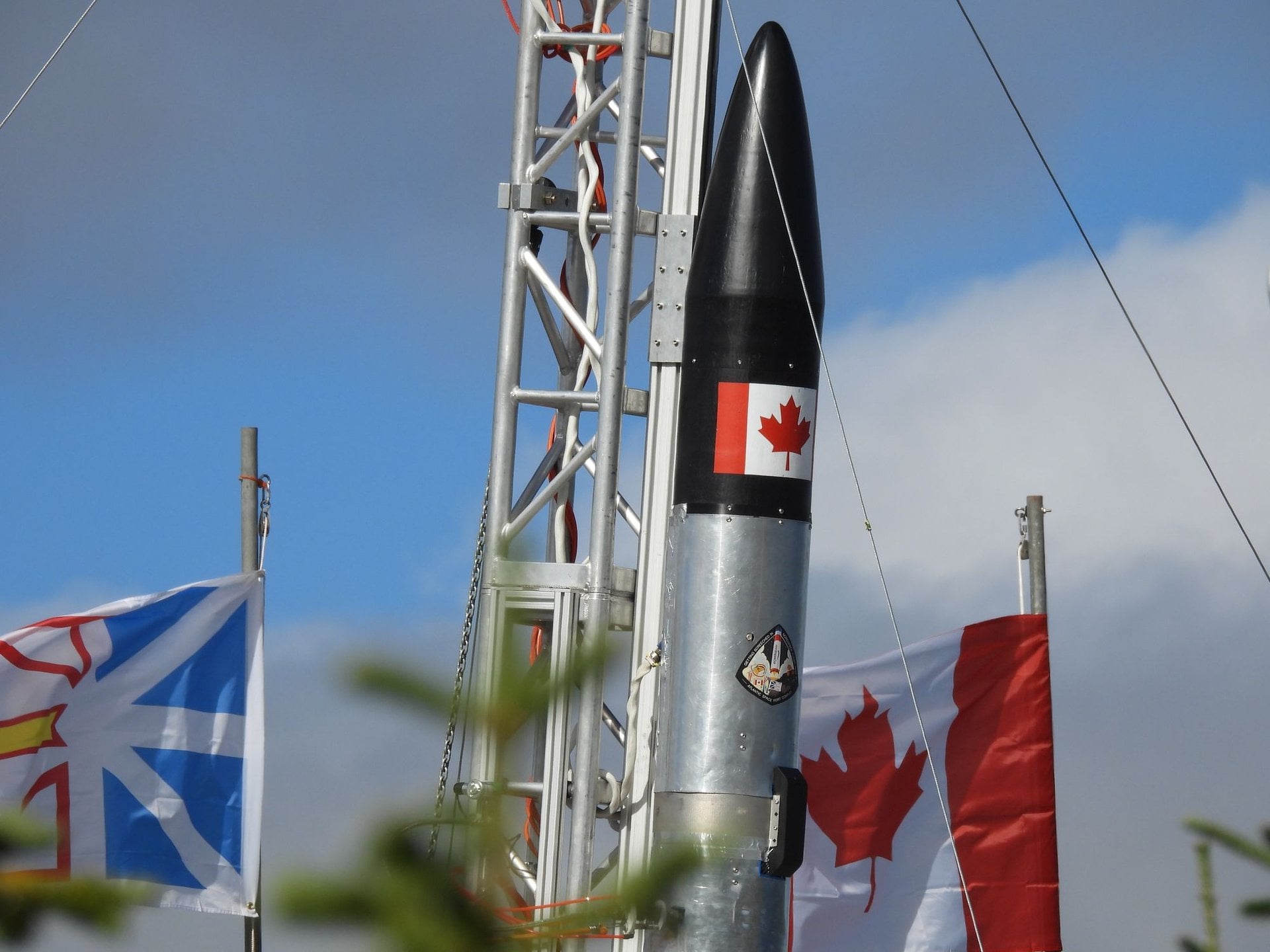
McGuinty hinted at this in his speech, saying Ottawa does not want to be entirely dependent on third parties to launch rockets (though he didn't name names). McGuinty also announced that Canada plans to become a full member of the NATO Starlift initiative, an Overarching Space Policy entered into by NATO allies to create a space-launch network to safeguard satellite communications against potential threats (like Russia and China).
Stephen Matier, CEO of Maritime Launch Services, said that a sovereign launch capability is a big step for Canada, and the federal contract sends a strong signal to the market about the spaceport's development. "For years, we've been taking our satellites from MDA Space or Kepler or those here in Canada and writing big cheques to SpaceX to launch them from Florida or from California," he said. "SpaceX is selling extra space on their rockets ... but you don't get to go where you want to go or when you want to go."
Sarah Gallagher, a former CSA adviser and now the director of Western University's Institute for Earth and Space Exploration, said there are not many countries worldwide with sovereign launch capabilities:
We have our own space assets in outer space, and so being able to access them immediately with resources that we have control over is quite important. The other thing is that having a launch site actually in Nova Scotia is really advantageous. The latitude of Nova Scotia can give you access to different kinds of orbits, which is useful depending on what you're trying to do. Obviously, we care a lot about the North, and so having a launch site that's at northern latitudes can be used for that.
In related news, the Canadian aerospace company NordSpace (based in Markham, Ontario) was selected as a winner of the "Launch the North: Accelerating Canada's Sovereign Access to Space" challenge. This incentive competition aims to accelerate the advancement of Canadian-designed launch vehicles and supporting technologies, and enable domestic launch capability.

The challenge is administered by the Department of National Defense (DND) and the Canadian Armed Forces (CAF) through the Innovation for Defence Excellence and Security (IDEaS) program (launched in February). This program provides funding and expertise to advance the research and development of defense-related technologies. The competition will award a total prize pool of up to $105 million over three years, divided into three phases.
Per the competition, NordSpace has been awarded a $8.33 million Phase 1 grant to fund the development of its Tundra orbital launch vehicle, an end-to-end orbital launch system that aims to be Canada's first domestically designed, built, and operated rocket. This two-stage rocket relies on a modular turbopump-fed liquid bipropellant propulsion system, known as the "Hadfield engine," which powers both the multi-engine first-stage cluster and the single-engine vacuum-optimized second stage, thereby reducing development and risk.
The Tundra rocket is reportedly capable of delivering over 500 kg (1,100 lbs) to Low Earth Orbit (LEO) and over 350 kg (770 lbs) to a Sun-Synchronous Orbit (SSO). The upgraded version, the Tundra+ configuration, will reportedly be able to deliver 1,100 kg (2,425 lbs) to LEO and 850 kg (1875 lbs) to SSO. The Hadfield's modular engine architecture also offers the potential for direct scaling that could lead to NordSpace's planned Titan medium-lift vehicle, targeting a payload capacity of over 5,000 kg (11,000 lbs) to LEO. As NordSpace CEO & Founder Rahul Goel said in a company statement:
At NordSpace, we have been working for years to develop scalable end-to-end space launch capabilities for Canada, and today our nation has sent an unequivocal signal that Canada too will become a spacefaring nation capable of assured access to space. For NordSpace, sovereign launch is certainly about securing our national interests, building a stronger economy, and supporting our allies.
However, it is also about healthier food on our plates, clearer communication with loved ones, faster responses to environmental challenges, reshoring advanced manufacturing, and revivifying Canadian dynamism.
The Defense Industrial Strategy and Launch the North represent the most significant investment in Canadian space launch capability in the nation's history. As Canada's reliance on space-based communications, navigation, intelligence, surveillance, and early warning systems deepens, the absence of a sovereign launch capability is a national security issue. These programs and the investments they entail are seen as a way to secure Canada's strategic autonomy in space, promote innovation, and establish Canada as a leader in commercial and defense-oriented space services.