
The light, rare element boron, better known as the primary component of borax, a longtime household cleaner, was almost mined to exhaustion in parts of the old American West. But boron could arguably be an unsung hero in cosmic astrobiology, although it's still not listed as one of the key elements needed for the onset of life.
Found on earth, inside the Sun, and in meteorites, boron is likely present in all the other solar system bodies. Despite its interesting chemistry, however, boron-bearing molecules have yet to be positively identified in the interstellar medium. That’s partly because boron is not formed in standard stellar nucleosynthesis.
“Boron doesn’t form in stars like most other elements, however, things like galactic cosmic rays and supernovas create high energy particles that hit other element nuclei; those nuclei break apart, and that process can form boron,” Patrick Gasda, a geologist at Los Alamos National Laboratory in New Mexico, told me via email.
In the Solar System and in primitive planetary material boron remains only a trace element.
“On earth, it is also not a major component of the crust, but what is striking is how effectively surface geochemistry and the global water cycle amplify its local availability relative to its average cosmic abundance,” Felipe Fantuzzi, a lecturer in Chemistry at the University of Kent in the U.K., told me via email.
While boron is not one of the prime elements that's considered necessary for life such as CHNOPS (carbon, hydrogen, nitrogen, oxygen, phosphorus, and sulfur), there’s evidence that boron could help build the precursors of Ribonucleic Acid (RNA).
“Boron in water may have helped during the chemical reaction that formed the first RNA, a form of proto life,” said Gasda. “The ‘RNA World hypothesis’ is one of the leading ideas about the origin of life. The jury is still out, however, as to whether this is how life formed on earth.”
But here on earth, boron may have helped stabilize RNA molecules as they formed from their raw chemical ingredients.
“Unlike many heavier elements formed in stars, boron is produced mainly when high-energy cosmic rays collide with carbon, nitrogen, and oxygen nuclei in the interstellar medium,” said Fantuzzi.
These collisions “shatter” the larger nuclei into lighter fragments --- via a process known as spallation --- and boron is one of the products, says Fantuzzi.
Its exotic origin is likely why boron is relatively rare compared with elements like carbon or oxygen. Yet how boron makes the journey from space into prebiotic planetary surface settings remains a key puzzle.
“If boron is transported mainly in minerals and dust grains, its availability depends on the delivery and processing of solid material in planet-forming regions,” said Fantuzzi. “If even a small fraction of boron can be carried by gas-phase molecular species, that opens an additional pathway for distributing boron into young planetary systems.”
The identification of boron carriers in the interstellar medium would help clarify how and where boron becomes chemically available in environments such as planetary surfaces that may later support prebiotic chemistry.
A decade ago, using the NASA’s Mars Curiosity rover, Gasda and colleagues detected boron on the red planet’s surface for the first time ever.
The Curiosity rover’s ChemCam focused a laser onto the surface so that elements that make up the rock emit light that is subsequently analyzed by the instrument’s spectrometer. ChemCam found that all its boron detections were in rocky gypsum veins present in Gale Crater’s ancient lakebed.
That’s how we determined that boron was likely present in groundwater in Gale Crater’s past, says Gasda.
Borates, a molecular compound of oxygen and boron, are crucial to preserving the sugar ribose which quickly decomposes in water.
Borates, in turn, stabilize ribose, the simple sugar that with phosphate forms the backbone of RNA, as Gasda and colleagues wrote in their 2017 paper in Geophysical Research Letters. Borates may thus have been a necessary bridge from abiotically produced organic molecules to RNA-based proto-life on Earth, the authors noted.
In fact, most of the rocks inside Gale Crater were extensively altered by water some 3.5 to 4 billion years ago, when the red planet had an atmosphere and liquid water on its surface.
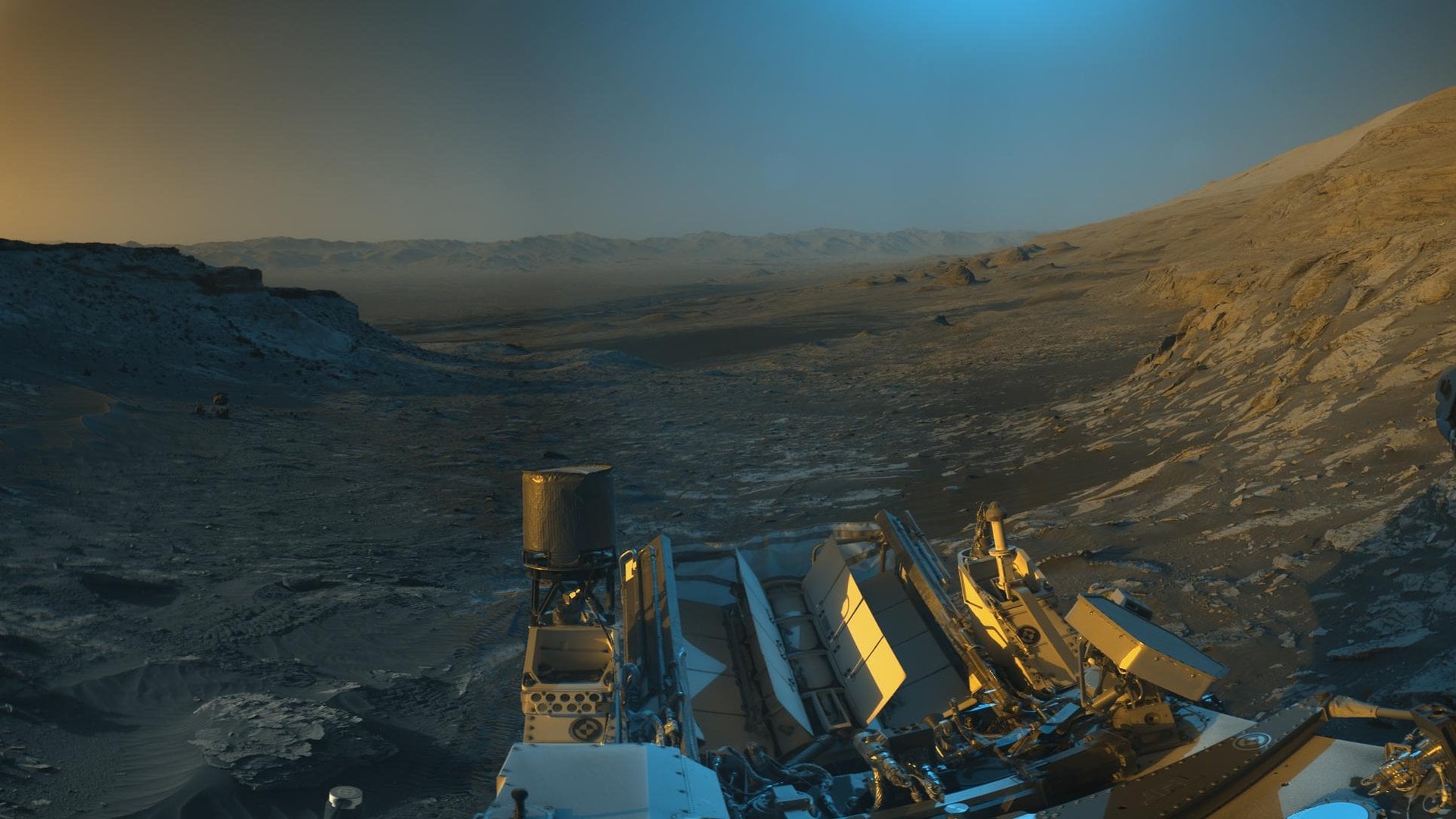 *Curiosity Rover inside Gale Crater. NASA/JPL-Caltech*
As for finding more boron on Mars?
“NASA’s Perseverance rover is currently exploring Jezero Crater,” said Gasda. “While we haven’t detected boron in Jezero yet, finding it there would be confirmation that it was more widespread in ancient Mars lakes.”
Could life start and persist without boron?
Even though it remains a rare element in the broader cosmic context,
boron may be a powerful prebiotic facilitator wherever liquid water, oxygen-rich minerals, and active surface cycling are present, says Fantuzzi.
But as Fantuzzi notes, detecting any boron molecule in interstellar space would be a breakthrough.
“It would become a new tracer of how elements are processed and transported between diffuse clouds, dense clouds, and star-forming regions,” said Fantuzzi. “Boron chemistry has the potential to inform broader models of chemical enrichment over cosmic time.”
The Bottom Line?
“Boron and RNA synthesis is just one steppingstone along the path to form life,” said Gasda. “But we really don’t know the breadth of possible alien biochemistries that could evolve on other planets in our own solar system, much less on exoplanets.”
Sources:
