
Astronomers don't have to work hard to find binary stars in the Milky Way. They're common, even abundant. For a long time, they thought that these stars are unlikely to host exoplanets. The complex gravitational environment made things so chaotic, so the thinking went, that the planet formation process is disrupted.
The competing gravitational pulls from both stars wreak havoc on the protoplanetary disc, warping it or even destroying it. This can prevent gas and dust from clumping together. When rare planetesimals do form in these systems, they're prone to gravitational kicks that can eject them into interstellar space.
However, in recent years, astronomers have detected several dozen circumbinary exoplanets. How does the planet formation process play out in these environments, and what type of planets are likely to form there?
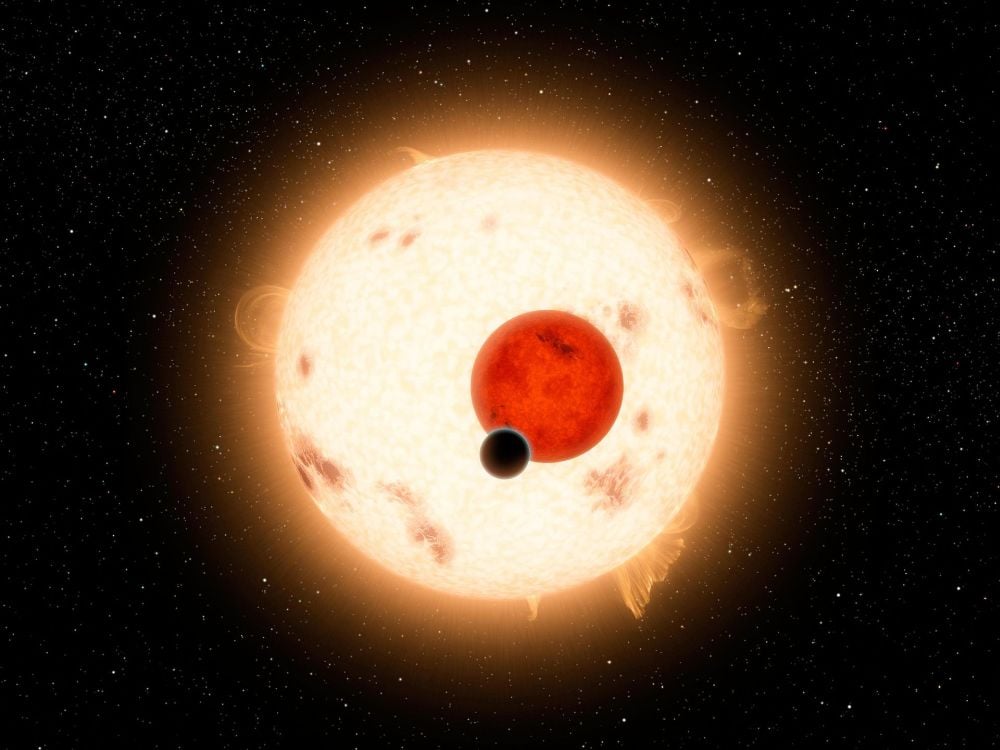 *This artist's illustration shows Kepler-16b, the first confirmed exoplanet in a circumbinary disk. It orbits a binary pair consisting of an M-dwarf (red dwarf) and a more massive K-type star, also called an orange dwarf. Image Credit: By NASA/JPL-Caltech - PIA14724: Where the Sun Sets Twice (Artist Concept), Public Domain, https://commons.wikimedia.org/w/index.php?curid=16505873*
New research dives into these questions. It shows that exoplanets in binary systems may be common after all. It's titled "The formation of circumbinary planets through disc fragmentation," and it's published in the Monthly Notices of the Royal Astronomical Society. The authors are Matthew Teasdale and Dimitris Stamatellos, both from the Jeremiah Horrocks Institute for Mathematics, Physics, and Astronomy at the University of Lancashire in the UK.
There are two primary planet formation paths. One is accretion, and it applies to rocky worlds. It starts with dust grains sticking together in a protoplanetary disc until pebbles form. Then the pebbles merge to become rocks, then boulders, then a planetesimal. The planetesimal can continue growing and can even attract an atmosphere. This is a slow, bottom-up process.
The other process is a top-down process called disc instability or disc fragmentation. In this scenario, instabilities form in the disc around a star, and regions collapse into densities. This is similar to how stars form, and may describe how gas giants form. It can happen quickly, in only a few thousand years possibly. The disc fragmentation process is what the researchers are focused on.
"Over 50 circumbinary exoplanets have been discovered in recent years, with several of them being gas giants on wide orbits (>10 au)," the authors write. "The aim of this work is to investigate whether these planets can form through circumbinary disc fragmentation due to gravitational instability."
There are two types of discs in a binary system. One type is the circumstellar disc, and one surrounds each single star. The other type is the circumbinary disc, and it surrounds both stars. The researchers simulated both types with different temperatures to see how planets could form in both.
"We perform hydrodynamic simulations of marginally unstable (i) circumstellar discs, (ii) circumbinary discs with the same temperature profile as the circumstellar discs (fiducial model), and (iii) realistic circumbinary discs heated individually by each star of the binary," the authors write. Fiducial model is the baseline that the other discs are compared to. It's kind of like the control group in a double-blind study.
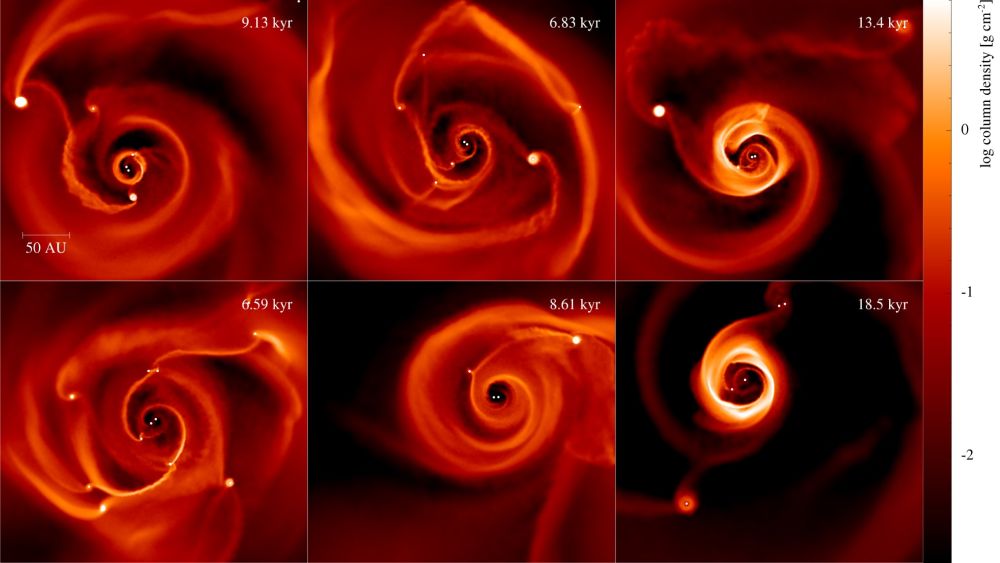 *These are some snapshots from the simulation of realistic circumbinary disks with 5 au separations. Each column is for different binary mass ratios, and the two rows represent different binary eccentricities. Different numbers of planets with different masses and separations form in each. Image Credit: Teasdale and Stamatellos 2026. MNRAS*
This research doesn't totally counteract the idea that the region near binary stars is too chaotic to allow planets to form. Instead, it suggests that at wide distances, gravitational instability can still happen and planets can still form.
“Close to a binary star it’s simply too violent for planets to form,” said Dr. Matthew Teasdale who led the research as part of his PhD project. “But move farther out and the disc becomes an ideal environment for planet formation.”
"We find that discs around binaries with wider separations fragment earlier and more efficiently than those around closer binaries, and earlier than circumstellar discs," the researchers write in their paper.
Realistic circumbinary discs formed the largest number of planets in the simulations, 9 +/- 0.9 protoplanets per disc. Fiducial circumbinary discs formed 6.5 +/- 0.6 protoplanets per disc, and circumstellar discs formed 7.5 +/- 0.8 protoplanets per disc.
Planetary masses were different between the scenarios, too. In the realistic circumbinary simulation, planetary masses were lower than those in the circumstellar discs. More of them are in the planetary mass range, too, which means these discs are likely to form gas giants rather than brown dwarfs or low-mass stars.
The planets are on very wide separations, which isn't surprising. "Fragmentation occurs predominantly beyond a binary-imposed forbidden region of ~50 au, leading to final orbital radii peaking at ~100 au," the authors write.
But there's some bad news for planets that form around a circumbinary disc. Because these planets form an n-body system with the pair of stars, their gravitational interactions aren't stable and predictable, leading to ejections. "We also find that in circumbinary discs dynamical interactions eject a higher fraction of protoplanets than in circumstellar discs, producing free-floating objects, with ejection velocities on the order of 2-6 kms-1," the authors write.
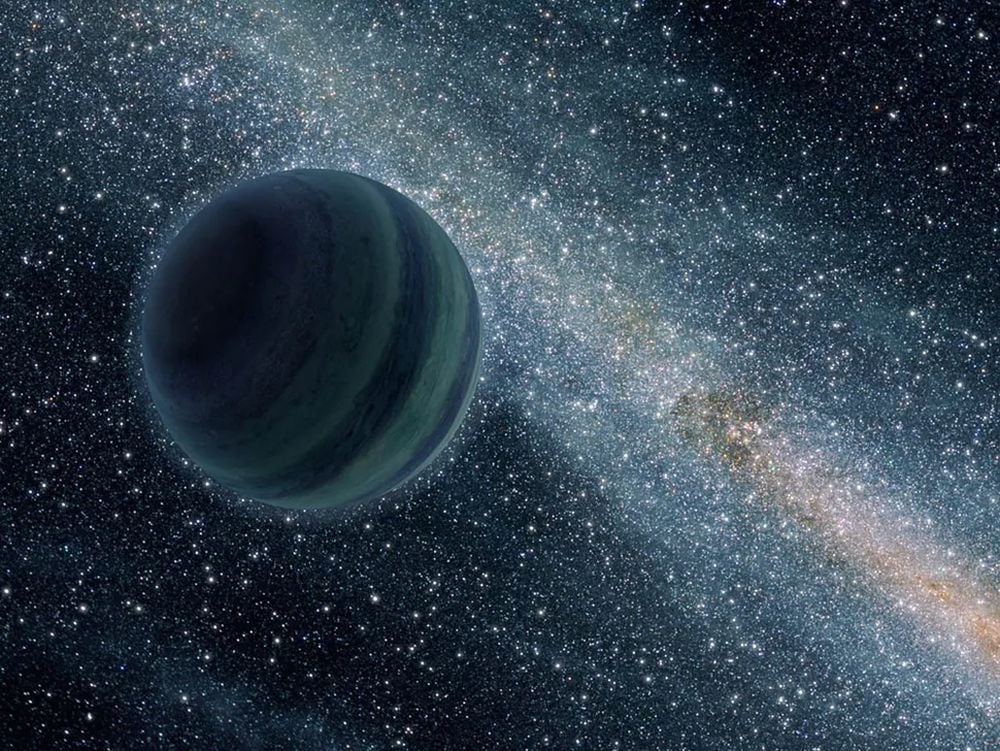 *This artist's illustrations shows a rogue planet drifting through space, untethered to any star. There could be more rogue planets in the Milky Way than there are planets attached to solar systems. Many of these planets could have originated in circumbinary disks. Image Credit: NASA/JPL-Caltech/R. Hurt*
“Binary stars were once seen as hostile environments for planet formation," co-author Dr. Dimitris Stamatellos said in a press release. "What we’re finding is that they can actually be extremely productive. Once you get past the danger zone, planets can form quickly and in large numbers.”
The results show that gas giants are more likely to form due to fragmentation in circumbinary disks than circumstellar discs with the same stellar masses. It's because circumbinary discs fragment at lower disc masses and form more protoplanets than the same mass in a circumstellar disc. The mass available in the disc is distributed among a larger number of planets.
"We therefore conclude that fragmentation driven by gravitational instability represents a viable and potentially significant formation channel for circumbinary gas giant planets," the authors write.
