Scientists continue to push the boundaries of astronomy and cosmology, thanks to next-generation instruments that can see farther and clearer than ever before. Through these efforts, astronomers have observed some of the earliest galaxies in the Universe. In turn, this has led to refined theories and timelines of galactic formation and evolution. In a recent study, a team of astronomers led by the University of Pittsburgh (UPitt) uncovered what could be the earliest barred spiral galaxy ever observed. This finding helps constrain the timeframe in which bars first emerged in the Universe.
The research was led by Daniel Ivanov, a physics and astronomy graduate student in the Kenneth P. Dietrich School of Arts and Sciences at the University of Pittsburgh. Based on observations made with the NASA/ESA/CSA James Webb Space Telescope (JWST) with data from Space Telescope Science Institute (STScI), the team spotted a barred spiral galaxy (COSMOS-74706). After analyzing data from Webb's spectrometers, the team determined that this galaxy existed roughly 11.5 billion years ago. He and his team presented their findings on Jan. 8th, 2026, at the 247th meeting of the American Astronomical Society (AAS) in Phoenix, Arizona.
According to the Hubble Sequence, galaxies begin as spheroidal masses of stars with little gas, dust, or newly forming stars. Over time, these galaxies merge with others to become spirals, which are so-named because of how their structure consists of spiral arms extending from a central bulge. Barred spirals, such as the Milky Way, also have a bar-shaped linear arrangement of stars across their centers, which play an important role in their evolution by funneling gas inward from the outer reaches, feeding the supermassive black hole in the center, and suppressing star formation throughout the stellar disk.
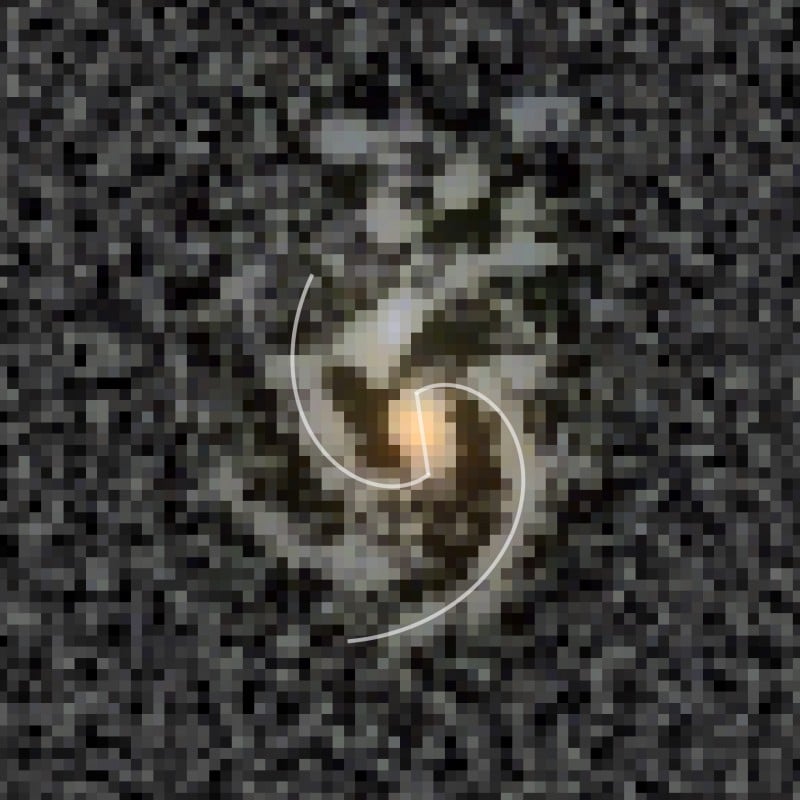
While researchers have reported barred spiral galaxies that are even older, analyses of these candidates have been less conclusive, since the observations were made using gravitational lensing or relied on measurements of the galaxies' redshifts. Whereas the former method is hampered by the blurring of light sources due to the lens's gravitational influence, redshift measurements are subject to errors and uncertainties of 10-15%. Neither method is as definitive as spectroscopy, which was used to validate the age of COSMOS-74706.
The discovery of a barred spiral galaxy this early in the Universe was not entirely surprising, as some simulations suggest that bars were forming in galaxies as far back as 12.5 billion years. However, observational evidence of such structures has been much harder to come by, making this a significant discovery that helps constrain the timeline of galactic evolution. As Ivanov stated in a UPitt press release:
This galaxy was developing bars 2 billion years after the birth of the Universe. Two billion years after the Big Bang. It's the highest redshift, spectroscopically confirmed, unlensed barred spiral galaxy. In principle, I think that this is not an epoch in which you expect to find many of these objects. It helps to constrain the timescales of bar formation. And it’s just really interesting.
Further Reading: University of Pittsburgh, AAS