
The platypus is one of evolution's loveable, oddball animals. The creature seems to defy well-understood rules of biology by combining physical traits in a bizarre way. They're egg-laying mammals with duck bills and beaver-like tails, and the males have venomous spurs on their hind feet. In that regard, it's only fitting that astronomers describe some newly-discovered oddball objects as 'Astronomy's Platypus.'
The discovery consists of nine galaxies that also have unusual properties and seem to defy categorization. The findings were recently presented at the 247th meeting of the American Astronomical Society in Phoenix. The results are also in new research titled "A New Population of Point-like, Narrow-line Objects Revealed by the James Webb Space Telescope," and available at arxiv.org. The lead author is Haojing Yan from the University of Missouri-Columbia.
"We report a new population of objects discovered using the data from the James Webb Space Telescope, which are characterized by their point-like morphology and narrow permitted emission lines," the authors write in their research. "Due to the limitation of the current data, the exact nature of this new population is still uncertain."
"It seems that we’ve identified a population of galaxies that we can’t categorize, they are so odd. On the one hand they are extremely tiny and compact, like a point source, yet we do not see the characteristics of a quasar, an active supermassive black hole, which is what most distant point sources are," said Yan.
The research team started with a sample of about 2,000 point sources from three different JWST surveys: the Cosmic Evolution Early Release Science Survey (CEERS), the Ultra Deep Survey (UDS), and the Cosmic Evolution Survey (COSMOS). Out of that sample they found nine point sources from between 12 to 12.6 billion years ago. The powerful JWST captured spectra from these sources, and those spectra did not line up with spectra from known objects. They can't simply be stars because they're much too distant. They're too dim to be quasars, which are among the most luminous objects in the Universe. They're similar to the 'green peas' discovered by citizen scientists, but are even more compact than those.
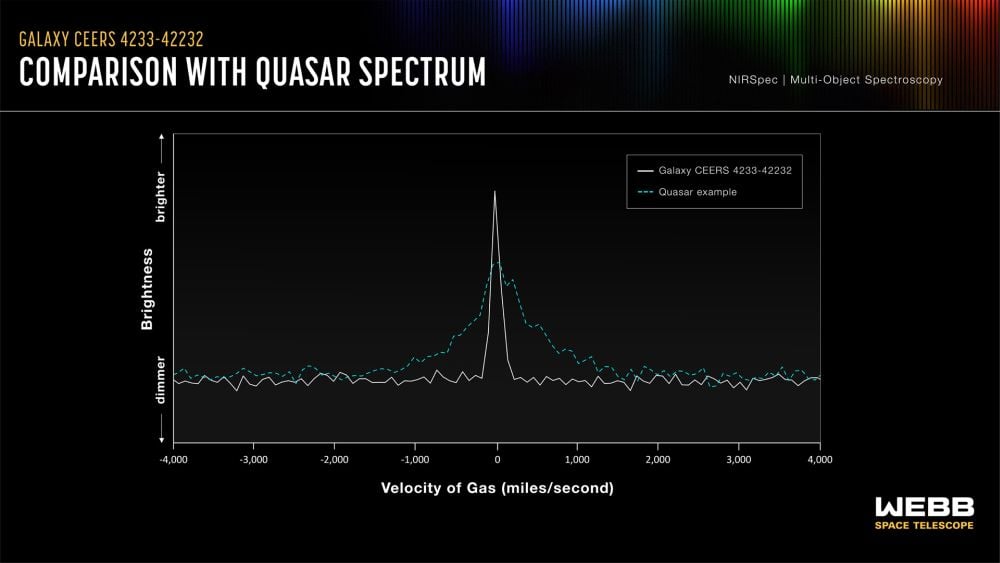 This graphic illustrates the pronounced narrow peak of the spectra that caught researchers’ attention in a small sample of galaxies, represented here by one named CEERS 4233-42232. It is the combination of a narrower-than-expected spectra, along with a tiny, point-like appearance, that makes these galaxies stand out. Typically, distant point-like light sources are quasars, but quasar spectra have a much broader shape. The quasar's is broader becasue matter is rotating rapidly around the SMBH, and that clearly isn't happening in the unusual point sources. Image Credit: NASA, ESA, CSA, Joseph Olmsted (STScI)
“I looked at these characteristics and thought, this is like looking at a platypus. You think that these things should not exist together, but there it is right in front of you, and it’s undeniable,” Yan said in a press release.
Yan compares the spectra of the point sources to the genetic code of the platypus, saying "Like spectra, the detailed genetic code of a platypus provides additional information that shows just how unusual the animal is, sharing genetic features with birds, reptiles, and mammals. Together, Webb’s imaging and spectra are telling us that these galaxies have an unexpected combination of features."
Yan was emphatic in his press conference at the 247th AAS Meeting. "The bottom line here, our objects are not quasars," he explained.
But Yan also said that their platypus point sources could be within the larger family of active galactic nuclei, because astrophysicists know that there are narrow-line AGN. "The problem is that narrow-line AGN are not point-like," he said, pouring cold water on that possibility. If they are among the AGN family, "they must be a new kind," he said.
Graduate student researcher Bangzheng Sun, also from the University of Missouri-Columbia, analyzed the data to see if they sources could be star-forming galaxies. “From the low-resolution spectra we have, we can’t rule out the possibility that these nine objects are star-forming galaxies. That data fits,” Sun said in a press release. “The strange thing in that case is that the galaxies are so tiny and compact, even though Webb has the resolving power to show us a lot of detail at this distance.”
At the press conference, Sun said, "We also checked that alternative that these can be normal star-forming galaxies." These types of narrow emission lines are seen in these types of galaxies. "Just like duck bills are normally seen in ducks," he quipped. He added that if they are star-forming galaxies, they must be very young, all less than 200 million years old.
But there's a problem with interpretation. "If they are indeed star-forming galaxies, then their point-like appearances are very difficult to understand," Sun said.
If they're so young and so early in their formation, then they're peacefully forming stars from the inside out. "This is a process we have not seen before," Sun said.
“I think this new research is presenting us with the question, how does the process of galaxy formation first begin? Can such small, building-block galaxies be formed in a quiet way, before chaotic mergers begin, as their point-like appearance suggests?” Yan said in the press release.
In the end, the researchers conclude that they're almost certainly seeing a new population of galaxies. They could be a new kind of AGN that are in very faint galaxies, "low-luminosity and hostless," as they describe it in their paper. They could be a new kind of star-forming galaxy.
To find out for sure, two things are needed: a larger sample of these 'platypuses', and higher-resolution spectra.
"Regardless of their exact nature, this population of point-like, narrow-line objects deserve further investigations, and deeper, medium-resolution spectroscopy will be critical in the future diagnostics," the authors write in their paper's conclusion.
The JWST has a track record of revealing things in the early Universe that are forcing us to rethink what we know. That's the point of building it and launching it. To discover things that force researchers to work harder to explain them, thereby advancing our scientific horizons.
When scientists first examined a deceased platypus in 1799, they thought it was a prank. They thought it was made up of several other animals sewn together. But it wasn't, and over time it became clear that this animal hold an important place in evolution and biology. Will the same thing happen with 'Astronomy's Platypus?'
“We cast a wide net, and we found a few examples of something incredible. These nine objects weren’t the focus; they were just in the background of broad Webb surveys,” said Yan. “Now it’s time to think about the implications of that, and how we can use Webb’s capabilities to learn more.”
