
China made history in June 2024 when the Chang'e-6 mission made the first lunar sample-return in history, sending 1,935.3 grams (roughly 4.25 pounds) of lunar regolith and rock to Earth. Analysis of these samples has revealed a great deal of information about the Moon's composition and geological history, as well as notable differences between the two hemispheres. This data is crucial as China, NASA, the ESA, and other space agencies, along with commercial partners, plan to build lunar bases on the far side of the Moon in the near future.
These missions are all targeting the South Pole-Aitken Basin as a potential building site because of its many permanently shadowed regions (PSRs) that contain vast amounts of water ice. In addition, the study of these samples is helping scientists to address several unresolved questions about the Moon's geological evolution. Among them is the open question of how impacts - like the massive one that excavated the South Pole-Aitken Basin ca. 4.25 billion years ago - affected the Moon's deep interior and reshaped the surface.
In a recent study, Chinese scientists from the Institute of Geology and Geophysics (IGG) of the Chinese Academy of Sciences (CAS) conducted a new analysis of basalt samples returned by the Chang'e-6 lander. Their findings revealed that the major impact event that created the basin also heated materials deep within the Moon, leading to the loss of certain volatile elements. Through high-precision isotope analysis, the researchers detected minute variations in isotope ratios and precisely captured traces left by the impact.
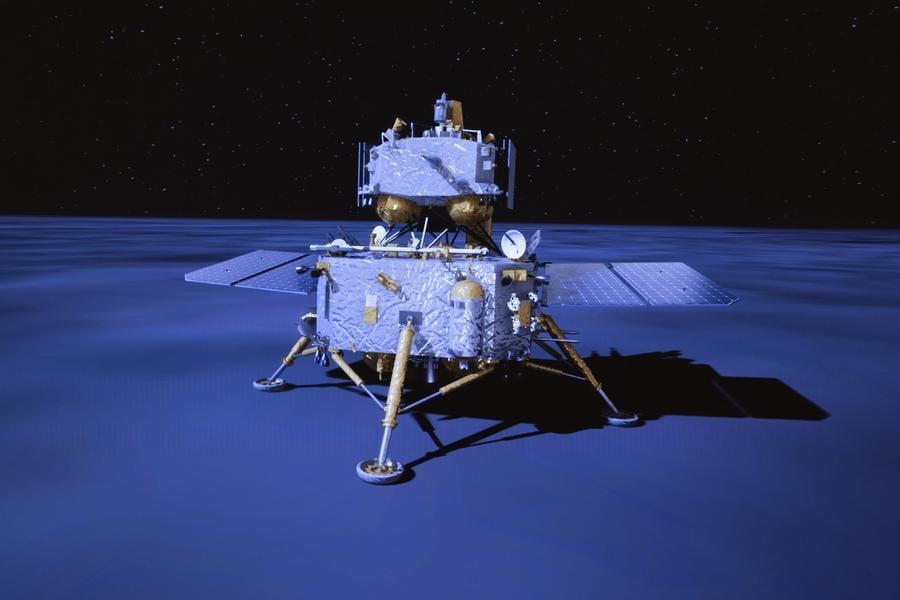 *A rendering of China's Chang'e 6 lunar lander shows its solar panels with the sample return module on top. Credit: CAST via Xinua*
Addressing how impacts affected the Moon is very important to scientists, as impacts are considered the dominant external force shaping the lunar surface over time. This is in contrast to Earth, where the geological landscape and surface changes are driven by tectonic activity. As the team reported, the high-temperature environment caused by the massive impact had a measurable effect on moderately volatile elements like potassium, zinc, and gallium. The elements were of particular interest because they are prone to volatilization and isotopic fractionation at high temperatures.
This essentially makes these "isotopic fingerprints" a means of measuring the temperature and pressure conditions caused by impacts, thus providing clues about how impacts have transformed the lunar crust and mantle. Another interesting find was the differences they noted between the Chang'e-6 samples and those returned by the Apollo astronauts from the near-side of the Moon. The basalts obtained from the far side exhibit a significantly higher proportion of the heavier potassium-41 isotope. To determine the exact cause, the research team considered several possible factors, including cosmic rays, volcanic activity, and impactor deposition.
In the end, they confirmed that the difference was caused by an early large-scale impact that altered the potassium isotope composition in the deep lunar mantle. This impact would have created the extreme conditions that led to the loss of the lighter potassium-39 isotope and the enrichment of the heavier potassium-41 isotope. They also concluded that the loss of volatile elements suppressed later volcanic activity on the Moon's far side.
These findings are the latest in a series of discoveries that are reshaping our understanding of how large impacts influenced the geological evolution of the far side of the Moon. They also reinforce the conclusion that there were significant differences in the evolution of the near and far sides over the course of billions of years. Moreover, they highlight the significant contributions Chinese missions and scientists are making in the ongoing process of learning how the Moon and Earth co-evolved
Further Reading: Global Times
