
A team of predominantly Canadian researchers are using massive galaxy clusters and the JWST to study low-mass galaxies from 13.5 billion years ago all the way up to 5 billion years ago. The clusters are used as gravitational lenses to expand the JWST's reach. It's called CANUCS, the Canadian NIRISS Unbiased Cluster Survey.
CANUCS uses all three of the powerful space telescope's near-infrared instruments—NIRSpec, NIRCam, and NIRISS—to gather high quality images and spectra for thousands of galaxies. The CANUCS data set contains the galaxies' distances, luminosities, star formation histories, metallicities, dust properties, sizes and morphologies.
The first data from CANUCS was released only recently in a paper titled "CANUCS/Technicolor Data Release 1: Imaging, Photometry, Slit Spectroscopy, and Stellar Population Parameters." It's published in the Astrophysical Journal Supplement Series, and the lead author is Ghassan Sarrouh, a PhD candidate at York University in Toronto, Canada.
"Extragalactic deep fields offer the furthest glimpse into the past that astronomical observations can achieve," the authors write. "Limited by the impossibility of observing cosmic evolution directly on human timescales, unbiased, wide-field surveys are necessary to provide statistical snapshots of galaxy populations at different cosmological epochs."
The JWST was built for this type of work. As part of the CANUCS effort, it captured some fantastic images of the five galaxy clusters used as gravitational lenses. One of them is the MACS J1149 cluster, which is about 5 billion light-years away. It contains at least 300 galaxies, and likely a few hundred more. MACS J1149's claim to fame is that it hosts the most distant individual star ever detected when it was found in 2018. It's named Icarus and is more than *9 billion* light-years away. (Now a star named Earendel, detected in 2022, is the most distant at 28 billion light-years.)
MACS J1149 is well-known as a powerful gravitational lens. It's one of six galaxy clusters that the Hubble investigated in its Frontier Fields Program. MACS J1149, and the other clusters, were chosen because they're such powerful gravitational lenses. Now it's being featured as the NASA/ESA/CSA James Webb Space Telescope Picture of the Month.
More than just a brilliant and colorful picture of the cluster and countless background galaxies, the image illustrates the power and utility of gravitational lensing.
The cluster is in the center of the image where the bright white galaxies are. Scattered around the outside of the galaxy cluster are streaks of stretched light from distant galaxies. The foreground cluster magnifies and warps their light, creating arcs and and other warped shapes. A reddish spiral galaxy is visible right under the galaxy cluster, and its arms are mangled and misshapen by the foreground cluster's overwhelming gravity.
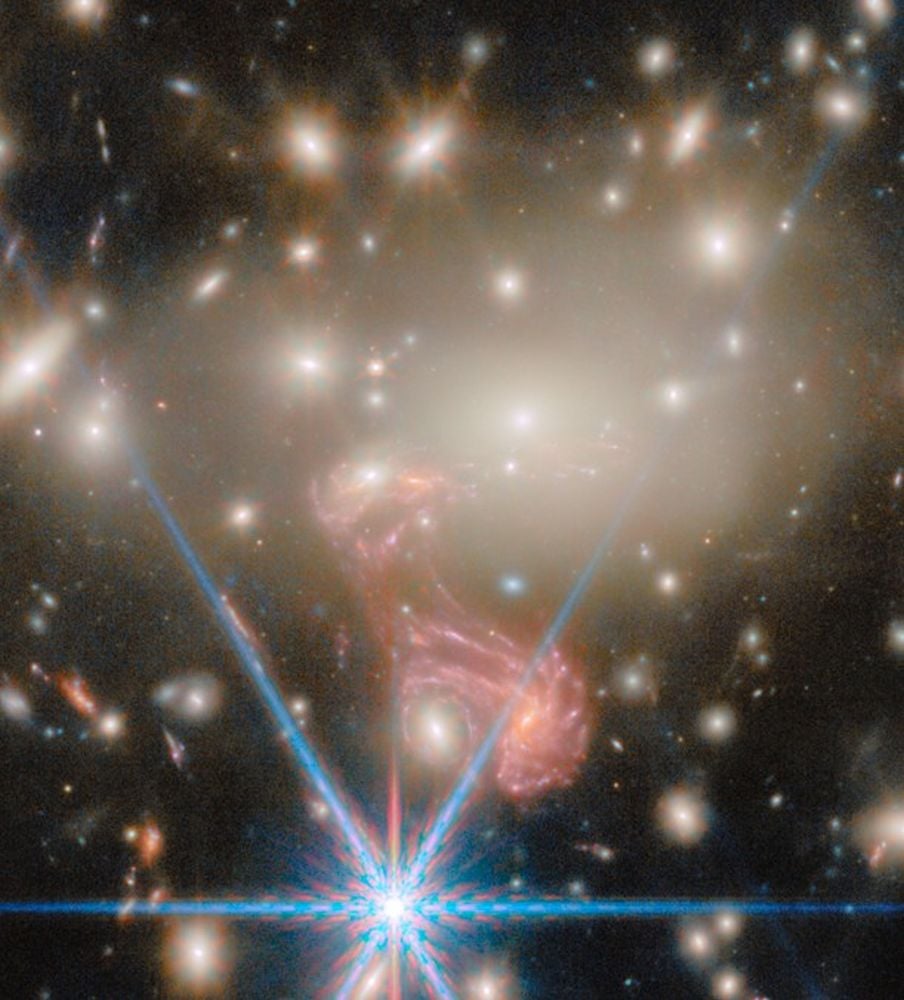 *This zoomed-in image of MACS J1149 highlights the powerful effect the cluster has on light that passes by. The light from a distant background spiral galaxy is warped by the cluster's gravity, its spiral arms stretched out and misshapen. Image Credit: ESA/Webb, NASA & CSA, C. Willott (National Research Council Canada), R. Tripodi (INAF - Astronomical Observatory of Rome). LICENCE: CC BY 4.0 INT or ESA Standard Licence*
Everything without diffraction spikes is a galaxy in this image. Even the faintest of background dots is an entire galaxy.
We don't know how many galaxies there are in the Universe. But many of them have crossed our observational horizon, thanks to the accelerating expansion of the Universe, and are forever beyond our reach. Even with unlimited time and perfect instruments, they're simply beyond our grasp.
Gravitational lensing is the only way to bring some distant galaxies into view. But it only works when the foreground cluster, the background galaxies, and us, the observers, are all lined up properly.
Despite some observational challenges, like contamination from intra-cluster light (ICL), gravitational lensing is a powerful natural tool. "Lensing clusters present a unique opportunity to detect novel phenomena that would otherwise be out of reach," the authors of the paper write.
