
I once filmed down a salt mine in North Yorkshire, descending into a dark matter laboratory buried deep underground where scientists wait for the rarest of collisions, dark matter particles interacting with ordinary matter. They're still waiting. But above ground, looking outward rather than inward, Professor Tomonori Totani from the University of Tokyo may have found what those underground detectors haven’t, dark matter revealing itself through light.
The challenge has always been fundamental thought since dark matter doesn't interact with electromagnetic force. It doesn't absorb, reflect, or emit light. It's invisible not because it's hiding, but because photons pass straight through it. We've only known dark matter exists through its gravitational effects for example the extra mass needed to explain why galaxies rotate faster than visible matter allows and why galaxy clusters don't fly apart.
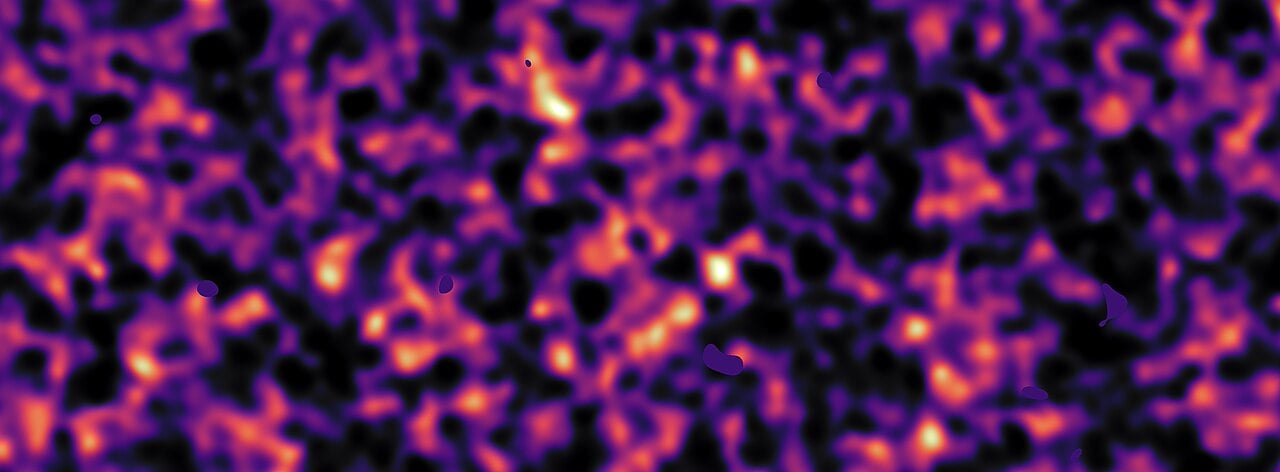 Dark matter map for a patch of sky based on gravitational lensing analysis of a Kilo-Degree Survey (Credit : Kilo-Degree Survey Collaboration/H. Hildebrandt & B. Giblin/ESO)
Many researchers believe dark matter consists of WIMPs, weakly interacting massive particles, perhaps 500 times heavier than protons. Theory predicts that when two WIMPs collide, they annihilate each other and release gamma rays with specific energies.
Totani and team found exactly that signature in Fermi telescope data, gamma rays with 20 billion electronvolts of energy forming a halo structure extending toward the galactic center. The shape matches theoretical predictions for dark matter distribution. The energy spectrum matches WIMP annihilation models and the frequency of collisions falls within predicted ranges. Crucially, more common astronomical phenomena can't easily explain these gamma rays. Other known sources don't produce this energy signature in this distribution pattern.
"If this is correct, to the extent of my knowledge, it would mark the first time humanity has 'seen' dark matter and it turns out that dark matter is a new particle not included in the current standard model of particle physics.” - Professor Tomonori Totani from the University of Tokyo.
If this is indeed evidence of dark matter, then the standard model, which describes all known particles and forces, will need revision. A new particle, possibly even the most abundant matter in the universe would need to be added.
Before that day however, independent researchers must verify Totani's analysis strengthening the claim dramatically. Finding the same gamma ray signature from dwarf galaxies within the Milky Way's halo, for instance, would support the dark matter interpretation. These smaller systems also contain concentrated dark matter but different astrophysical backgrounds, making them ideal for confirmation.
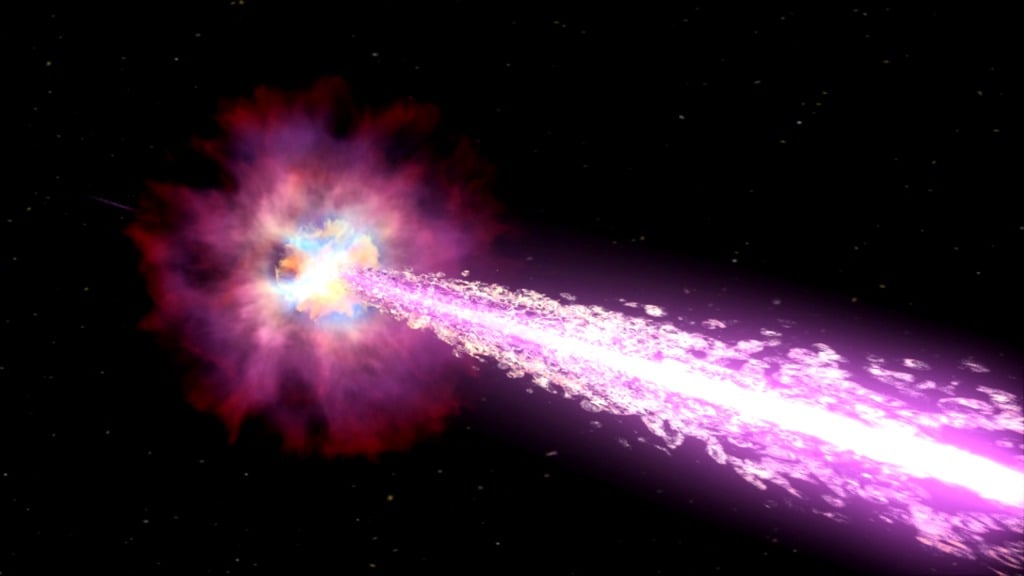 Gamma rays are not just produced during interactions with dark matter. As a high mass star explodes in this artist’s concept, it produces a jet of high energy particles. We see GRBs when such gets point almost directly at Earth (Credit: NASA/Swift/Cruz deWilde)
Meanwhile, in salt mines and laboratories worldwide, detectors continue their vigil, waiting for dark matter to give away its presence through the tiniest interaction with ordinary matter. Perhaps the answer was always in the sky, written in gamma rays, waiting for instruments sensitive enough to read the message.
Source : After nearly 100 years, scientists may have detected dark matter
