Time again for a tale of things dark and mysterious. A tale of dark matter. It's a well-told tale, but this time it involves an interactive dance between dark matter and neutrinos.
Dark matter is, of course, the majority of matter in the cosmos according to the standard model and, by definition, cannot interact strongly with light. There has been some debate as to whether dark matter interacts with itself, but so far there isn't strong evidence to suggest that it does. Neutrinos also don't interact strongly with light. Technically, neutrinos meet the conditions of dark matter, but neutrino particles zip around so quickly that they are a hot form of dark matter. But observational evidence we have for dark matter suggests that it is cold. So neutrinos aren't the dark matter we're looking for.
Given that neither neutrinos nor cold dark matter interact strongly with matter, there hasn't been much to suggest that they interact with each other. But a new study argues that they do. The authors even suggest that these interactions would help solve the Hubble tension problem.
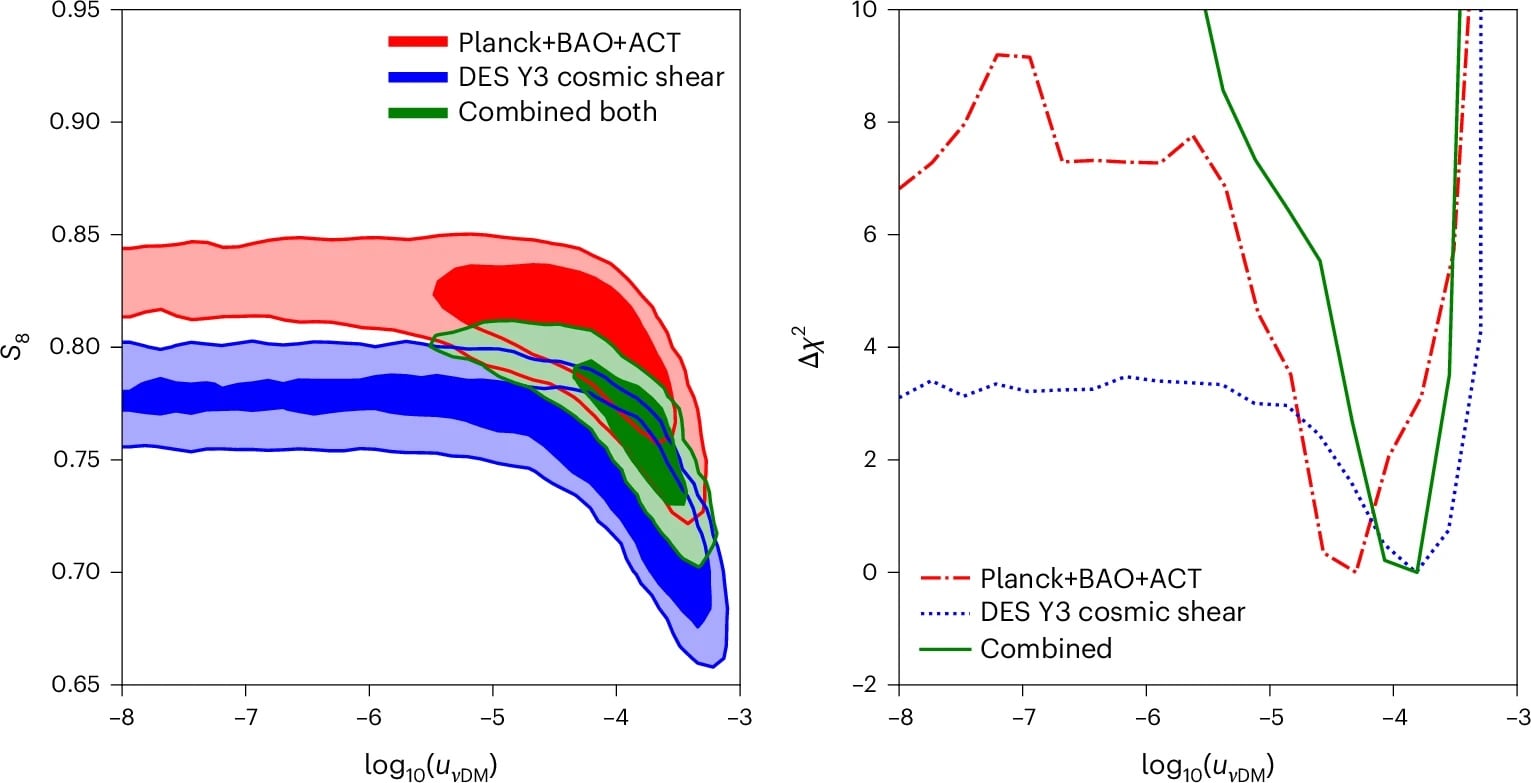
The study looked at an effect known as cosmic shear. It's a subtle distortion in the way galaxies gravitationally lens distant light. If a galaxy were perfectly spherical, then the lensing of distant objects would be circular. But since galaxies aren't perfectly circular, the lensed light is distorted. For an individual galaxy this doesn't mean much, but galaxies within a large structure of galaxies have an intrinsic alignment, and this gives a slight alignment or shear to lensed objects. By making large surveys of gravitationally lensing galaxies, we can measure the cosmic shear and understand the large-scale structure of the Universe.
The key is that if neutrinos and dark matter interact, this would affect the large scale structures of galactic clusters and voids, which would impact our measure of cosmic shear. Using cosmic shear data gathered by the 3-year Dark Energy Survey gathered by the Blanco Telescope in northern Chile, the authors found an interaction level of about 1 part in 10,000. While this suggests there is an interaction between the two, the statistical significance of their result is only 3σ, which isn't strong enough to be considered proof.
Future cosmic shear surveys, such as ones that can be done with Rubin Observatory data, will soon allow the team to narrow things down. If new observations confirm their results, we will have to re-examine our standard comsological model. But it's also possible that the data won't hold up, and this idea will join the multitude of others that give us possibilities but no answers. For now the dark mystery continues.
Reference: Zu, Lei, et al. "A solution to the S8 tension through neutrino–dark matter interactions." *Nature Astronomy* (2026): 1-9.