
Photographing a black hole has presented one of the most unique challenges in astronomy, you can't simply point a telescope at one and snap a picture. Black holes are so distant and compact that capturing their details requires multiple radio telescopes scattered across the globe to work together as one gigantic instrument. The catch? They all need to observe at precisely the same moment, with their signals perfectly aligned.
That synchronisation challenge has long been the limiting factor in radio astronomy. Now, researchers at KAIST in South Korea have developed a solution that replaces the electronic reference signals telescopes have traditionally used with something far more precise, laser light.
The technology centres on optical frequency comb lasers, instruments that emit not one colour of light but tens of thousands of extremely accurate frequencies spaced at regular intervals. Picture a ruler where each marking is a precise wavelength of light, all perfectly spaced and stable. Because scientists know the exact frequency of each "tooth" on this optical comb and can tune the intervals with atomic clock precision, they effectively have an ultra precision measuring tool made entirely of light.
Professor Jungwon Kim from KAIST's Department of Mechanical Engineering led the development team. Their innovation was to feed these laser combs directly into radio telescope receivers, establishing a common reference from the very beginning of signal processing. This differs fundamentally from traditional approaches that relied on electronic signals to coordinate observations.
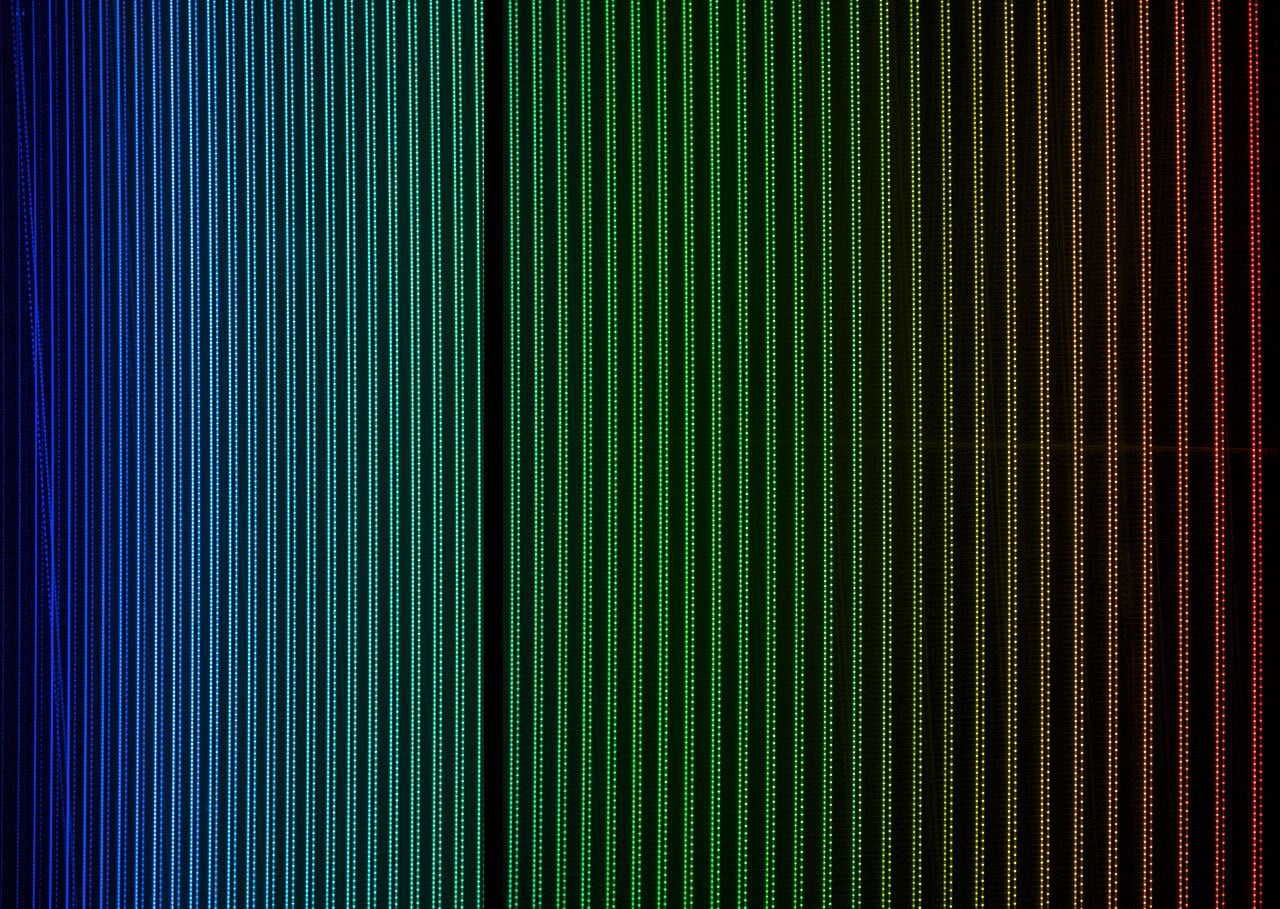 Spectrum of the light from the two-laser frequency combs installed on the High Accuracy Radial Velocity Planet Searcher (Credit : ESO)
The problem with electronic methods becomes acute at higher radio frequencies. As astronomers push to observe at shorter wavelengths to see finer details, precisely calibrating the phase relationships between different telescopes becomes increasingly difficult. Electronic signals struggle to maintain the necessary stability and accuracy. It's like trying to use a flexible plastic ruler when you need measurements accurate to a fraction of a millimetre.
The laser approach sidesteps this limitation entirely by delivering an optical frequency comb directly to each telescope's receiver, the system establishes phase alignment with the fundamental stability of light itself. The team verified their technology through observations at the Korea VLBI Network's Yonsei Radio Telescope, successfully detecting stable interference patterns between telescopes. Recently, they expanded testing to include the KVN Pyeongchang Radio Telescope, demonstrating that the system works across multiple sites simultaneously.
The implications of this study extend well beyond black hole photography itself. The same precision timing technology could enable intercontinental atomic clock comparisons accurate to unprecedented levels, improve space geodesy measurements that track Earth's subtle movements, and enhance tracking of deep space probes.
The research represents what Kim describes as overcoming the fundamental limits of electronic signal generation by harnessing optical precision. For astronomers hoping to capture ever sharper images of black holes and other distant objects, it's a significant step toward making distant radio telescopes behave like one impossibly large instrument.
