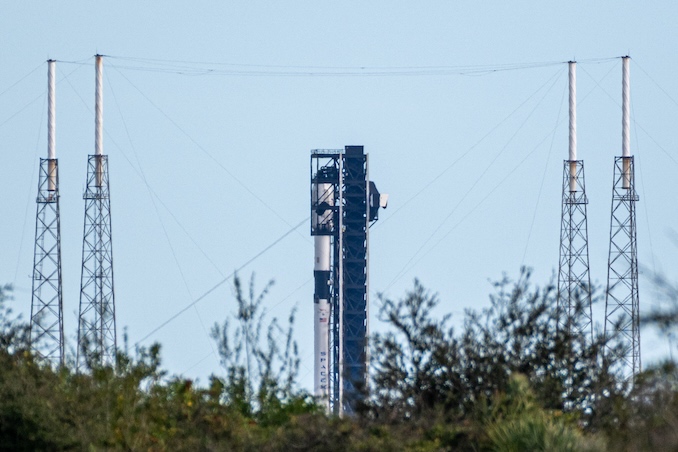

File: A Falcon 9 rocket stands ready to launch a Starlink mission. Image: SpaceX
SpaceX is aiming for pre-dawn launch from Vandenberg Space Force Base on Wednesday morning. The flight will be the 160th of a Falcon 9 rocket so far in 2025.
File: A Falcon 9 rocket stands ready to launch a Starlink mission. Image: SpaceX
SpaceX is aiming for pre-dawn launch from Vandenberg Space Force Base on Wednesday morning. The flight will be the 160th of a Falcon 9 rocket so far in 2025.
A SpaceX Falcon 9 rocket lifts off from Space Launch Complex 40 (SLC-40) at Cape Canaveral Space Force Station (CCSFS) to begin the NROL-77 mission on behalf of the National Reconnaissance Office on Dec. 9, 2025. Image: Michael Cain / Spaceflight Now
Update Dec. 9, 2:44 p.m. EST (1944 UTC): SpaceX landed its booster at the landing zone.
The Soyuz MS-27/73S spacecraft carrying NASA’s Jonny Kim and two Russian cosmonauts undocked from the International Space Station Monday evening as the two spacecraft were sailing 262 miles above eastern Mongolica. Image: NASA
A NASA astronaut and two cosmonaut crewmates strapped into their Soyuz ferry ship Monday evening, undocked from the International Space Station and plunged to an on-target landing on the frigid steppe of Kazakhstan early Tuesday to wrap up an eight-month mission.
A SpaceX Falcon 9 rocket stands in the launch position at Launch Complex 39A at NASA’s Kennedy Space Center on Dec. 7, 2025, ahead of flying the Starlink 6-92 mission. SpaceX is using the Falcon 9 booster, 1067, which will make its record breaking 32nd flight. Image: Adam Bernstein / Spaceflight Now
SpaceX is set to achieve a couple notable milestones with its next Falcon 9 rocket launch from NASA’s Kennedy Space Center.
A SpaceX Falcon 9 rocket lifts off on the Starlink 11-15 mission from Space Launch Complex 4 East at Vandenberg Space Force Base on Dec. 7, 2025. Image: SpaceX
Update Dec. 7, 3 p.m. EST (2000 UTC): SpaceX confirms deployment of the 28 Starlink satellites.
The International Space Station is pictured from the SpaceX Dragon crew spacecraft during a fly around of the orbiting lab that took place following its undocking from the Harmony module’s space-facing port on Nov. 8, 2021. Image: ESA / NASA / T. Pesquet
After 25 years of continuous human presence, the International Space Station is heading into its final half decade of planned habitation.
File: A SpaceX Falcon 9 rocket stands in launch position at Space Launch Complex 4 East (SLC-4E) at Vandenberg Space Force Base ahead of the launch of the NROL-57 mission. Image: SpaceX
SpaceX is preparing for lunchtime launch from Vandenberg Space Force Base Thursday afternoon.
Technicians with NASA’s Exploration Ground Systems team use a crane to lift and secure NASA’s Orion spacecraft on top of the SLS (Space Launch System) rocket in High Bay 3 of the Vehicle Assembly Building at NASA’s Kennedy Space Center in Florida on Saturday, Oct. 18, 2025, for the agency’s Artemis 2 mission. Image: NASA/Kim Shiflett
The four astronauts who are to fly a loop around the Moon next year on the Artemis 2 mission were supposed to board their Orion capsule on Nov. 19 for a launch day rehearsal, but a problem with the spacecraft’s hatch delayed the practice run, NASA told Spaceflight Now.
Jared Isaacman, President Donald Trump’s nominee to be the next administrator of NASA, appears before the Senate Committee on Commerce, Science, and Transportation, Wednesday, April 9, 2025, at the Russell Senate Office Building in Washington. Image: NASA/Bill Ingalls
Jared Isaacman is set to appear before lawmakers once again for a hearing to become NASA’s next Senate-confirmed administrator.
An Arianespace Vega-C rocket lifts off from Europe’s Spaceport in Kourou, French Guiana, on Dec. 1, 2025, carrying South Korea’s KOMPSAT-7 satellite. Image: ESA-CNES-Arianespace/Optique Vidéo du CSG – S. Martin
South Korea’s latest Earth observation satellite was delivered into a Sun-synchronous orbit Monday afternoon following a launch onboard a Vega-C rocket by Arianespace.
File: A SpaceX Falcon 9 rocket stands in the launch position during sunset at Space Launch Complex 4 East (SLC-4E) at Vandenberg Space Force Base in California. Image: SpaceX
Update Dec. 2, 1:40 a.m. EST (0640 UTC): SpaceX confirmed deployment of the 27 Starlink satellites.
A glimpse of the 140 payloads onboard SpaceX’s Transporter-15 mission. Image: SpaceX
Update Nov. 28, 5:45 p.m. EST (2345 UTC): SpaceX deployed all payloads designed to separate from the rocket.
The Soyuz rocket launches to the International Space Station with Expedition 74 crew members: NASA astronaut Chris Williams, Roscosmos cosmonauts Sergey Kud-Sverchkov and Sergei Mikaev, onboard, Thursday, Nov. 27, 2025, at the Baikonur Cosmodrome in Kazakhstan. Photo: NASA/Bill Ingots
Astronomer-turned-medical physicist and now NASA astronaut Chris Williams joined two Russian cosmonauts aboard a Soyuz ferry ship Thursday for a Thanksgiving Day flight to the International Space Station, kicking off a planned eight-month stay in orbit.
A Rocket Lab Electron rocket lifts off from Mahia, New Zealand, to begin the ‘Follow My Speed’ mission on Nov. 20, 2025. Image: Rocket Lab
Earth observation company BlackSky revealed it was the ‘confidential customer’ whose satellite flew on a recent Rocket Lab Electron rocket. A BlackSky spokesperson confirmed to Spaceflight Now on Tuesday that its Gen-3 satellite was the payload onboard.
SpaceX scrubbed the Transporter-15 mission on Wednesday, Nov. 26, prior to loading liquid oxygen on the Falcon 9 rocket’s second stage. Image: SpaceX via livestream
Update 1:15 p.m. EST (1815 UTC): SpaceX scrubbed the launch attempt and is now targeting launch on Friday, Nov. 28.
File: A Falcon 9 rocket stands in the launch position at Space Launch Complex 40 (SLC-40) at Cape Canaveral Space Force Station ahead of the planned liftoff of the Starlink 6-61 mission on Oct. 22, 2024. Image: Adam Bernstein/Spaceflight Now
SpaceX is preparing for its third Falcon 9 launch in less than two days. The company is targeting a late afternoon flight from its workhorse pad at Cape Canaveral Space Force Station in Florida.
A SpaceX Falcon 9 rocket lifts off from Launch Complex 39A at NASA’s Kennedy Space Center to begin the Starlink 6-86 mission. Image: Spaceflight Now
Update Dec. 1, 3 a.m. EST (0800 UTC): SpaceX landed its booster on the droneship.
A Falcon 9 rocket rises from its Cape Canaveral launch pad, shrouded in ground fog, carrying 29 Starlink satellites to orbit on Nov. 22, 2025. Image: Adam Bernstein/Spaceflight Now.
SpaceX launched a Falcon 9 rocket from Cape Canaveral in the early hours Saturday as the company continues to expand its network of more than 9,000 satellites for the Starlink internet service.
The Boeing Starliner spacecraft is lifted at the Vertical Integration Facility at Space Launch Complex-41 at Cape Canaveral Space Force Station in Florida on Tuesday, April 16, 2024. Image: NASA/Kim Shiflett
In its latest shakeup to the Commercial Crew Program, NASA announced on Monday it has reduced the number of missions Boeing is required to fly to the International Space Station and changing the next flight from a crew mission to a cargo mission.
Falcon 9 booster B1100 lifts off from Vandenberg Space Force Base in California on its debut mission carrying 28 Starlink satellites. Image: SpaceX.
SpaceX launched a brand new Falcon 9 booster on a mission from California to deploy another batch of satellites for the company’s Starlink internet service.
A Falcon 9 rocket rises from a fog bank on Nov.20, 2025, making the 100th launch of the year from Florida’s Space Coast. Image: John Pisani/Spaceflight Now.
A Falcon 9 rocket lifted off from the Kennedy Space Center Thursday evening on a milestone mission marking the 100th launch from the Space Coast this year.
All Rights Reserved. 2025. SpaceZE.com